Blog Post: IIPSJ Attendance at the 44th WIPO Standing Committee on Copyright and Related Rights (SCCR)
IIPSJ Attendance at the 44th World Intellectual Property Organization Standing Committee on Copyright and Related Rights (WIPO SCCR)
Geneva, 6-8 November 2023
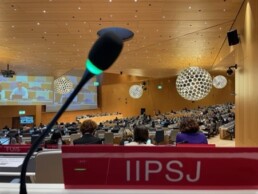
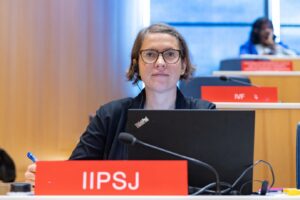
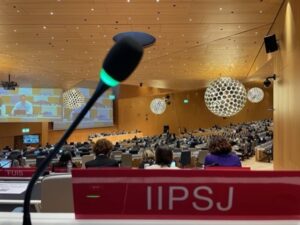
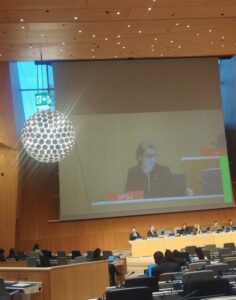
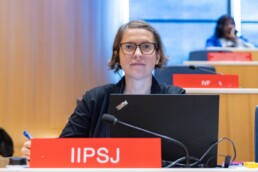
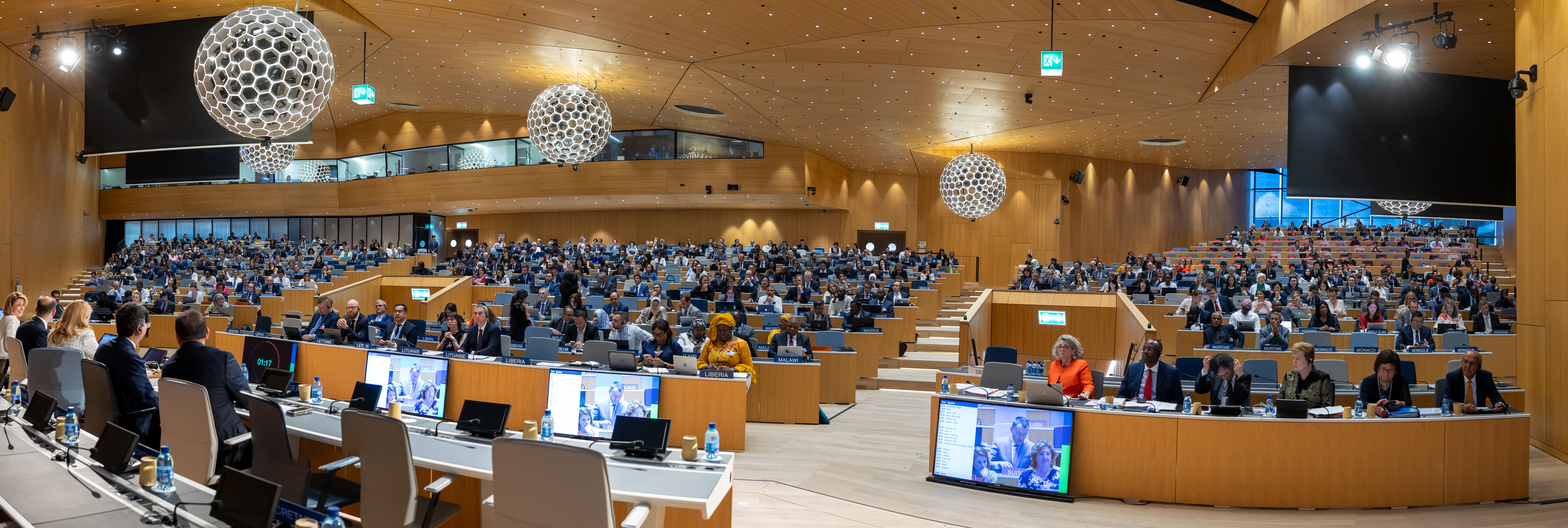
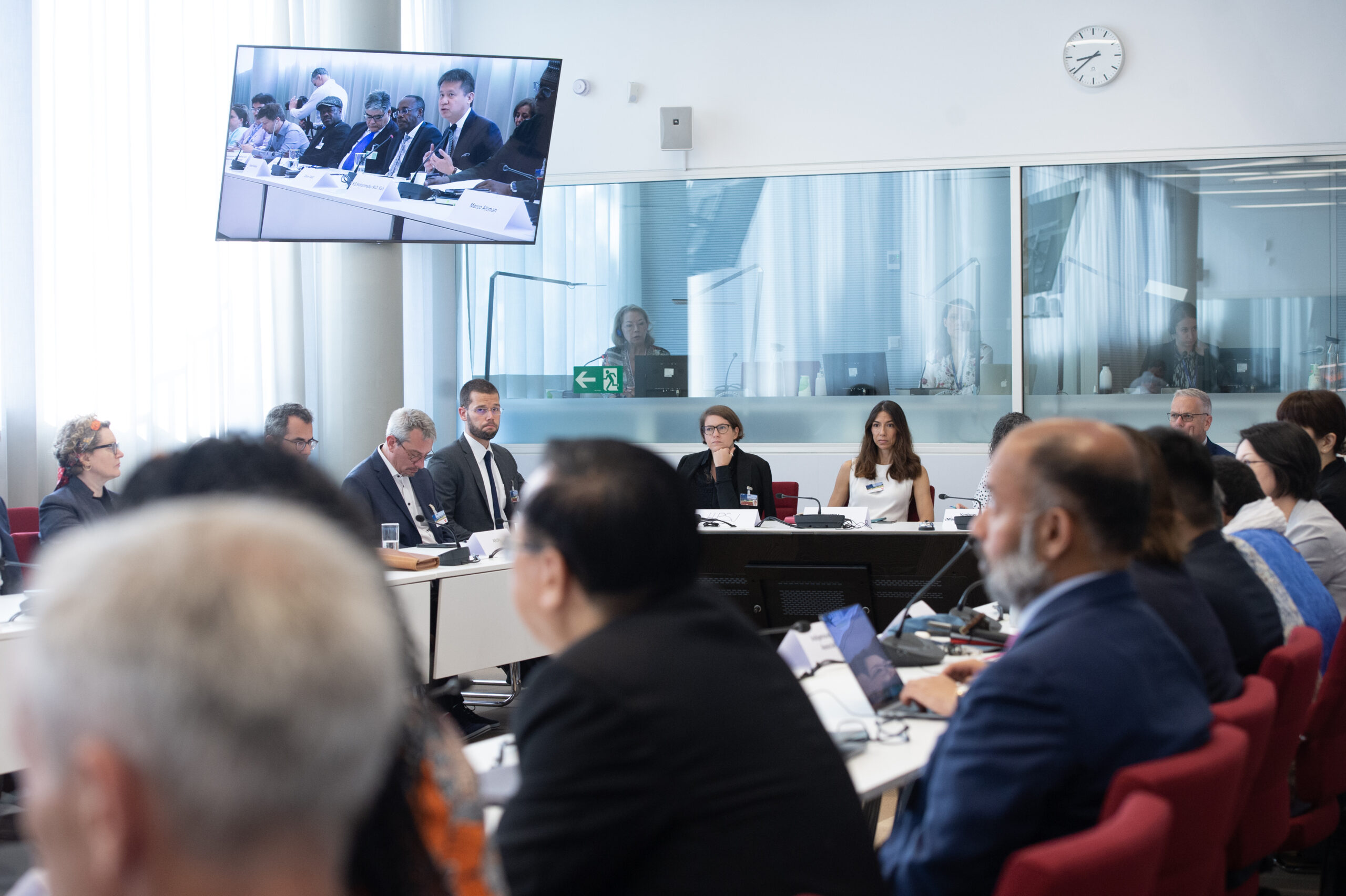
IIPSJ attended the 44th World Intellectual Property Organization (WIPO) Standing Committee on Copyright and Related Rights (SCCR), in their capacity as the WIPO Accredited Observer. IIPSJ submitted a written statement and attended the official hearings at the WIPO Headquarters in Geneva, with the Associate Director for International Programs, Dr. Metka Potočnik, attending the length of the proceedings in person. These assemblies brought together delegates from Member States in person, and online, and a significant number of observers. A full list of participants is available here, and all the sessions are available for viewing here.
IIPSJ attended the WIPO General Assemblies in July 2023, and at this latest meeting continued to grow strategic partnerships with Member States and other stakeholders, interested in creating access, inclusion and empowerment for under-represented creators and innovators in the global eco-system. Delegates at the SCCR discussed the two standing issues (broadcasting and limitations and exceptions) and some other matters, such as copyright in the digital environment. Full agenda can be viewed here. On copyright in the digital environment IIPSJ representative offered an oral intervention, highlighting the need to align the work of the SCCR with the work WIPO has done in its Intellectual Property Gender Action Plan, which was adopted in 2023 (see here). Furthermore, Dr. Potočnik stressed that all research and evidence collection from artists and creators must be intersectional, focusing not only on all genders, but also race, class, age, (dis)ability of the creators, inclusive IP systems are meant to protect. The written statement can be viewed here (page 3), and the oral intervention is available here (at 02:41:17).
IIPSJ will contribute to future discussions in WIPO, with the aim of building more inclusive IP systems across different jurisdictions. The IIPSJ team are working towards a meaningful participation in the 31st Session of the Committee on Development and Intellectual Property (CDIP) (see here), whilst awaiting the confirmation of the 2024 schedule, where further work will be presented. If you are interested in contributing to IIPSJ work in this space, do contact the IIPSJ directly.

Blog Post: IIPSJ Written Statement Submitted to WIPO
IIPSJ Written Statement to the 44th Session of the WIPO Standing Committee on Copyright and Related Rights (SCCR)
November 6-8, 2023
IIPSJ is a WIPO Accredited Observer, seated in the United States, focused on matters domestically, and internationally. IIPSJ examines intellectual property laws and policies to see where full participation of disadvantaged, excluded, and marginalized groups may need redressing. IP systems should offer access, inclusion, and empowerment for all, not only a select group. At this time, we would like to add a few observations of general nature, to the 44th SCCRR Agenda Item Number 8.1 on the Proposal for Analysis of Copyright Related to the Digital Environment.
The digital environment offers both opportunities, and risks for the creatives, sharing their works online. Effective IP protection and exploitation must be considered against the interests of various groups of stakeholders. There is evidence across jurisdictions, that not all artists, creatives, or musicians, are making comparable income, and that some groups are marginalized by the IP systems. In 2021, the UK Intellectual Property Office conducted a survey, finding that women make from music seven thousand pounds less than men, who on average make twenty thousand pounds a year.i In 2022, a larger sample investigating the earnings by Black artists found, that on average, Black women make twenty-five percent less than white women.ii In 2023, evidence found that Black musicians with disabilities, have fewer opportunities in the sector still.iii
IIPSJ has an extensive network of scholars and sister organizations, who have explored the effects of IP systems on different groups of inventors and creatives, and they agree that the personal characteristics, such as gender(s), race, nationality, age, disability, class (or other), matter when it comes to access and enjoyment of IP systems (an intersectional approach). Making art, as making music, is a social activity, where conditions in which the individuals create, matter. WIPO’s commitment to an inclusive IP regime is demonstrated, among other, by its activities under “Intellectual Property, Gender and Diversity” and its current WIPO IP Gender Action Plan (IP GAP). IP GAP’s vision of gender equality will rely on research “to identify the scope and nature of the gender gap in IP and ways to close the gap”.iv IIPSJ would add to the action plan and stress that firstly, WIPO IP GAP commitments should be implemented in other WIPO Studies, Analysis, and Action Plans, across all Divisions (such as the here discussed Agenda #8.1), and secondly, that this research must be intersectional, to avoid any correctives which could continue to ignore artists, creatives, or musicians, who are currently disadvantaged, excluded and marginalized by the creative industries.
There cannot be a socially just approach towards building an inclusive IP system, if we focus ‘on gender alone,’ or operate under the assumption that the digital space is full of opportunities, equal to all. There is ample research to demonstrate that not all artists or creatives, have equal access or opportunities, to share their innovation and imagination with the world, to the mutual benefit of all in the society.
Prepared by Dr. Metka Potočnik
IIPSJ Associate Director for International Programs
i Intellectual Property Office, ‘Music creators’ earnings in the digital era’ (2021). Available: https://www.gov.uk/government/publications/music-creators-earnings-in-the-digital-era.
ii Black Lives in Music (BLIM UK), ‘Being Black in the UK Music Industry: Music Creators Part I’ (2021). Available: https://blim.org.uk/report/. For general research on women in UK music: Vick Bain, ‘Counting the Music Industry: the Gender Gap; A study of gender inequality in the UK Music Industry’ (2019). Available: https://vbain.co.uk/research/.
iii Black Lives in Music (BLIM UK), ‘Unseen. Unheard. Race and Disability – Black disabled experience in the UK’s music industry’ (2023). Available: https://blim.org.uk/report-unseen-unheard/.
iv World Intellectual Property Organization, ‘WIPO Intellectual Property (IP) and Gender Action Plan: the Role of IP in Support of Women and Girls’ (2022) 4. Available: https://www.wipo.int/women-and-ip/en/4.

Blog Post: IIPSJ Selects 2023-2024 Wikimedia Race and Knowledge Equity Fellows
2023-2024 Wikimedia Race and Knowledge Equity Fellows
KYRA ABRAMS
Bio:
Kyra Abrams is second year doctoral student at the University of Illinois at Urbana-Champaign. Her research interests surround data autonomy and data privacy, specifically what data autonomy would be like through a critical informatics perspective. She previously received her B.A. from UC Berkeley, where she studied interdisciplinary studies with a focus on techpolicy. She plans to become a tenure track professor at an R-1 Institution. Her hobbies include baking, reading, and listening to new music.
Project Description:
Throughout the duration of the fellowship, I aim to research the intersections between data autonomy and intellectual property and discuss critical analysis of law, policy, and court decisions. I intend to use critical content analysis as my methodology. This research will result in a whitepaper that will make recommendations to researchers and policymakers surrounding ways in which to respect data autonomy in accordance with what has and hasn’t worked for intellectual property rights in regards to marginalized communities.
AKSHAT AGRAWAL
Bio:
Akshat Agrawal is a litigator working in the courts of Delhi. He has finished his Masters in Law and Technology from the University of California, Berkeley School of Law, with pro bono honors. His LLM Thesis- “Resolving Copyright’s Distortionary Effects” pursued under the supervision of Prof. Talha Syed, will be upcoming in the Annual Review of the Berkeley Technology Law Journal, and was awarded Google’s Inclusive Copyright Thesis Award for the year 2023. Akshat is deeply interested in Copyright reform from the lens of law and political economy to ensure an inclusive cultural and knowledge policy.
Project Description:
The point of Copyright law, often misunderstood, was, is, and has always been to protect people who want to express in their lives from involuntary subjection to a market society, where their agency to express and participate in meaning-making is stomped by the requirement to meet basic needs which are only realized by thriving in a constant race for sustenance– the race of market competition. The only point of this legal tool is to enable self-preservation for all to the extent necessary to realize basic needs so that one continues to have agency and is enabled to produce expression. It is not to form a market. It is to enable, that is to protect from the inherent market logic- the logic of competing for your basic needs, irrespective of your social structural position (defined by involuntary social relations- that precede and our constitutive of our roles), with people in differential positions. Enablement in its legal scope however has a limit, especially when the enablement of one conflicts with the enablement of another- given the resource involved – speech- inherently constitutes and is constitutive of self-determination. Thus, the tool and its subsidiaries ought to be rethought- re-conceptualized in terms of scope, in terms of a continuum, or in terms of whether this tool of the right to exclude is even the best tool to achieve this goal of enablement or protection from involuntary subjection to a market society for basic needs of human flourishing. My focus, here at IIPSJ, is on proportionate enablement an idea fundamental to devising a method of fairly enabling, as well as, allowing partial amelioration of the structural losses suffered by those who have been invisible for long. The project will specifically focus on inducing this idea of proportionate enablement in knowledge distribution and shall identify modes of remedying publisher-researcher relations through better contractual clauses that are more accessible for researchers, fulfill the need for enablement for authors as well as ensure reasonable and not windfall recompense for publishers.
KAINEN BELL
Bio:
Kainen Bell is a Ph.D. student in Information Sciences at the University of Illinois at Urbana-Champaign. His research uncovers algorithmic biases and follows the work of digital rights activists and organizers of anti-surveillance campaigns in Brazil who protest facial recognition camera initiatives. Kainen’s goal is to learn how Afro-Brazilian communities collaborate to resist and prevent the abuse of surveillance technologies. He holds bachelor’s degrees in social work and business administration from the University of Washington in Seattle, and a master’s degree in social work from Columbia University in New York. Prior to his Ph.D., Kainen completed a Fulbright Research Fellowship in Brazil.
Project Description:
Through the support of the Wikimedia Race and Knowledge Equity (WRKE) Fellowship Program I will dedicate my time into creating resources, documents, and publications to support the efforts of the national anti-surveillance campaign in Brazil (#TireMeuRostoDaSuaMira). Over the past year I have been in conversation with Brazilian digital privacy rights activists and human rights organizations, and they have requested information about organizing efforts in the U.S. such as privacy protection laws created to ban or restrict the uses of facial recognition Technologies and collection of biometric data. They hope to use this information as a reference point for their own local organizing efforts. Through this project I strive to create a bi-directional exchange of knowledge and resources between these global communities.
ALBERT FOX CAHN
Bio:
Albert Fox Cahn is the Surveillance Technology Oversight Project’s ( S.T.O.P.’s) founder and executive director. He is also a Practitioner-in-Residence at N.Y.U Law School’s Information Law Institute and a fellow at the Harvard Kennedy School’s Carr Center For Human Rights Policy, Yale Law School’s Information Society Project, Ashoka, and TED. Albert received his J.D., cum laude, from Harvard Law School (where he was an editor of the Harvard Law & Policy Review), and his B.A. in Politics and Philosophy from Brandeis University.
Project Description:
I will use the fellowship as an opportunity to research the impact of library content filtering in blocking access to knowledge, particularly emerging threats to open inquiry in K-12 school libraries. Content filtering debates have existed for many years, but they take on new urgency in the post-Dobbs era. Working with librarians in states that seek to radically criminalize abortion care, I can identify how growing political and legal pressure is restricting library-based internet access to medically accurate information about abortion and other controversial topics. I would also examine the discriminatory impact of such restrictions, highlighting how restrictions in library-based internet compound the digital divide. For deliverables, the project would provide (at a minimum) a whitepaper geared towards lay readers and the press, using S.T.O.P.’s proven capacity to garner significant media attention. Additionally, I could create public explainer materials for the web and social media, distilling the key themes into infographics and other easily shared materials. Time permitting, I would also create additional materials targeted at supporting impacted librarians.
SHUBHA GHOSH
Bio:
Shubha Ghosh is Crandall Melvin Professor of Law at Syracuse University College of Law where he teaches and researches in the fields on intellectual property commercialization and technology law. His scholarship focuses on exhaustion of intellectual property rights, biotech and biomedical patenting, and issues of distributive justice. He earned a BA from Amherst College, a PhD from Michigan, and a JD from Stanford.
Project Description:
My starting point for my work as a Fellow is to develop an overlooked criticism of the Bayh-Dole Act: its overemphasis on universities and its exclusion of other institutions that can serve to channel creative energies to the public. Elementary schools, secondary schools, magnet schools, young entrepreneurs’ clubs, art schools—each engage students in developing their creativity and inventiveness. Yet, there is little engagement with the debates over intellectual property, crowd sourcing, and follow-on innovation that pervade many universities. Often lessons about intellectual property are reduced to warnings against downloading or arousing fear of Internet piracy. Less attention is paid to harnessing creativity and invention to the values of exchange and transferring knowledge. Several initiatives from the Wikimedia Race and Knowledge Equity project could remedy these gaps. First, a comprehensive state by state study of programs at the elementary and secondary school levels that target creativity and inventiveness among students. Identified programs could be studied to see how they engage with science, technology, engineering, arts and mathematics. (STEAM) curricula. Having identified the programs, my fellowship work would develop a survey to identify the needs of several of these programs with particular attention to open questions of intellectual property, knowledge sharing, and distribution of resources for teaching and encouraging innovation. These questions will serve as the basis for identifying policy reforms at the state and federal levels, building in part on the promise of the Bayh-Dole Act while reforming its vision and policy reach beyond the universities. White papers would be the work product of this extensive research with the Wikimedia imprimatur and my scholarly skills targeting key policy figures at the federal and state levels to alert them about the overlooked potential for students to learn about the links among creativity, commercialization, and public dissemination. Wikimedia White Papers on this topic will educate policymakers about programs to promote innovation outside the university ecosystem and their needs as we create new knowledge ecosystems.
OROMA WOMEODU
Bio:
R. Oroma Womeodu earned a J.D. from Tulane University Law School and a Bachelor’s Degree in Political Science from Wingate University. During her time at Tulane she acted as Managing Editor of Tulane’s Journal of Technology and Intellectual Property where she fostered an interest in and focus on intellectual property protection for Black fashion designers and similarly marginalized creator groups. She is committed to ensuring all creators are afforded adequate access to IP protection and hopes to one day assist in policymaking that contributes to this goal in America as well as her home nation of Nigeria. She spends her free time on the tennis court coaching players ranging from beginner to advanced.
Project Description:
I will be working with Dr. John R. Whitman as a research assistant on his book Making the Most of Prison. In this role, my deliverables will include creating a white paper on current impediments for the copyright registration process for people in prison, researching and proposing an adjusted copyright registration process for imprisoned people, as well as creating a directory of attorneys and firms that do work in furtherance of protecting incarcerated people’s intellectual property and potentially organizing a panel discussion including these practitioners.

IIPSJ Attendance at the 64th World Intellectual Property Organization General Assemblies
(WIPO GA) (Geneva, 6-14 July 2023)
By Dr. Metka Potočnik (she/her/hers), Senior Lecturer in Law, Wolverhampton Law School
IIPSJ attended the 64th World Intellectual Property Organization (WIPO) General Assemblies (GA), in their capacity as the WIPO Accredited Observer. IIPSJ attended the official hearings at the WIPO Headquarters in Geneva, with the Associate Director for International Programmes, Dr Metka Potočnik, attending the length of the proceedings in person. These assemblies brought together a record number of delegates, with over 1,200 delegates in attendance, which exceeded the pre-Covid numbers of attendance in the General Assemblies. A full list of participants is available here, and all the sessions are available for viewing here.
IIPSJ previously observed several WIPO meetings online and took this GA as an opportunity to create strategic partnerships with Member States and other stakeholders, interested in creating access, inclusion and empowerment for under-represented creators and innovators in the global eco-system. IIPSJ representative attended the 10th WIPO-NGO Stakeholder Dialogue, which was organised in parallel with the 64th WIPO GA and took place on Monday, 10 July 2023, at WIPO New Building. WIPO Director General Tang and other WIPO experts met with over 40 Accredited Observers and NGOs, in discussing important issues, which require a multi-stakeholder response. The event has been placed in the spotlight for its importance, and more can be read here.
IIPSJ is aiming to contribute to the future discussions in WIPO, with the aim of building a more inclusive WIPO eco-system. The IIPSJ team are working towards a meaningful participation in the 44th Session of the Standing Committee on Copyright and Related Rights (SCCRR) (see here) and the 31st Session of the Committee on Development and Intellectual Property (CDIP) (see here). If you are interested in contributing to IIPSJ work in this space, do contact the IIPSJ directly.

2023 IP & Social Justice CLE Recap
“IIPSJ’s annual conferences played an important role in developing a social justice perspective in intellectual property law and policy. The Institute’s mission is a vital one”- Honorable Raymond T. Chen
These were some of the key reflections to come out of the 20th Annual Intellectual Property and Social Justice CLE Conference, held on March 3, 2023. The event marked more than two decades of increasing the education surrounding the nexus of intellectual property and social justice as well as broadening the knowledge of intellectual property practitioners across the globe.

 As part of the 20th anniversary, we celebrated the program and Institute founders with awards. IP Social Justice Lifetime Achievement Awards were given to Thomas L. Irving and Steven D. Jamar.
And we honored Professor Lateef Mtima with an award as well that read:
Presented to Lateef Mtima 
In recognition of your unwavering commitment to increasing diversity in intellectual property law and guiding the next generation of attorneys especially those from historically black colleges and universities
In appreciation of your contributions to the field of intellectual property law through your superior and thought-provoking authorship on the topic of intellectual property and social justice
In acknowledgement of your ongoing service to the intellectual property legal community through your teachings as a renowned lecturer and leadership as founder of the Institute for Intellectual Property and Social Justice.
For the CLE program, key attendee sessions included our annual IP Year in Review, social justice luncheon sessions: Unleashing American Innovation Act and Highlights from the Innovator Diversity Pilots Conference, as well as the annual Donald R. Dunner Judicial Panel, 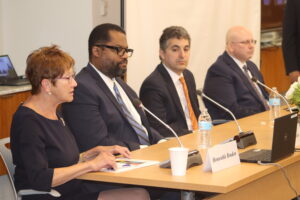 which included insights and reflections from the Honorable Leonard P. Stark, Judge with the United States Court of Appeals for the Federal Circuit, the Honorable Scott R. Boalick, Chief Administrative Patent Judge with the Patent Trial and Appeal Board in the U.S. Patent and Trademark Office, the Honorable Bryan F. Moore, Administrative Law Judge with the United States International Trade Commission, and the Honorable Susan G. Braden, Former Chief Judge (ret.) with the United States Court of Federal Claims.
The IP and Social Justice CLE Conference benefits from participation from all demographics within the IP legal community: attorneys in private practice, in-house counsel corporate departments, government agencies, and public interest NGOs, as well as members of the judiciary and government officials. In addition to the keynote sessions, this year’s breakout sessions included networking and discussions with counsel from Meta, Under Armour, J.P. Morgan, 3M Company, Freddie Mac, Visa and Pall Corporation, affording many the opportunity to gauge the current climate on the field in terms of fair use, trade secrets, and adding value as in-house counsel.
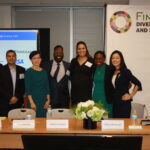



Year after year, the mantra of the conference remains the same – to expand the opportunities for minority attorneys to pursue careers and distinguish themselves in the field of intellectual property law. The Conference’s core objectives include:
● Educating minority and other IP attorneys on current developments in the law in an environment that highlights the social justice obligations of IP law.
● Providing minority and other attorneys in government, civil rights, public interest, and/or non-profit practice a free/nominal fee opportunity to develop IP practice skills.
● Providing an opportunity for experienced minority IP lawyers to demonstrate their expertise in the field to audiences they might not otherwise reach, while offering professional networking opportunities for minority and other IP attorneys.
Studies continue to confirm that African Americans and other minorities are severely underrepresented in intellectual property legal practice, notwithstanding the important contributions these communities make to intellectual property production and use in our society. Contributions from participants and speakers alike have enhanced the significance of the conference as the only intellectual property CLE program of its kind. Erika H. Arner, Managing Partner of Finnegan, Henderson, Farabow, Garrett & Dunner, LLP said, “Now more than ever we need organizations like IIPSJ, taking concrete and impactful actions to advance social justice and IP.”
The 2023 CLE sessions were:
- IP Law Year in Review – Trademark, Patent, and Copyright
- Donald R. Dunner Judicial Panel
- Highlights from the Innovator Diversity Pilots Conference
- Unleashing American Innovation Act
- Leading with IP and Adding Value to Corporations
- How Fair Is Fair Use? A Discussion About Andy Warhol Foundation v. Goldsmith
- In House Counsel Discussion on Trade Secret Law
- Updates on College Athletes NIL & Celebrities Right of Publicity
- Ethics
View the full list of videos here.
Thank you to our sponsors!
2023 HBCU IP & Tech Law Summit Recap
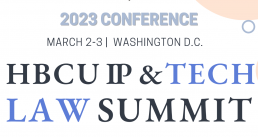
On March 2, 2023, IIPSJ, co-host Perkins Coie, and several sponsors, hosted the 5th Annual Microsoft Technology Summit to provide a comprehensive “diversity pipeline” experience for law students. During the Technology Summit, law students learned about new opportunities in intellectual property(IP) and technology law and policy practice.
Acting Principal Deputy National Cyber Director of the Office of the National Cyber Director Kemba Eneas Walden delivered the keynote speech to attendees alongside Founder of the HBCU IP & Tech Law Summit Charlie Bingham for a fireside chat. Acting Director Walden recounted her journey to her current role as a Hampton University graduate and addressed issues of cybersecurity that her office plans to handle as a result of President Joe Biden’s newest initiative.
The Summit consists of two key components: a full day of student-focused IP and technology law updates with networking and recognition of student academic and extracurricular achievement in these fields, including the presentation of “micro” scholarship awards paid directly to students. This year, the following were recipients of awards:
- D&I in Tech Ally Award
- Cameron Benton, NCCU
- Tech Law Policy Achievement Award
- Kayla Mitchell, 3L NCCU
- Samuel Cadet, HUSL
- Outstanding Achievement in IP Social Justice Award
- Daria Fogan, HUSL
- DeNashia Robinson, HUSL
- Brianna George, NCCU
- The IP & Tech Law Summit IP Social Engineer Award
- Michee Jacobs, HUSL
- Askhari Little, HUSL
- Tyrrell Ufot, NCCU
- The IP & Tech Law Summit IP Achievement Award
- Leandre’a Scott, NCCU
While the Summit was initially established for Howard Law students, it has since been expanded to include students at four historically black colleges and university law schools. In 2022 a pilot initiative was added to expand the scope of the program to assist students in finding internship opportunities in IP practice, and to provide internship stipends where the internships secured are uncompensated.
Some of the subjects covered during the event included data privacy, cryptocurrency, and blockchain and were presented by experts in the intellectual property field including executives from Uber, Perkins Cole, and Reed Smith hosting sessions such as:
- The Impact of Innovative Technologies on Society and the Practice of Law
- The Impact of Cryptocurrency and Blockchain on Society and the Practice of Law
- Paying it Forward: A Day in the Life of a Tech Lawyer
Find the full list of videos here.
Thank you to our sponsors!
Warhol v Goldsmith: Supreme Court Upholds that Every Artist Matters, Photographer Goldsmith Protected Warhol Case
Every Artist Matters: The Supreme Court Protects Photographer Goldsmith in the Warhol Litigation
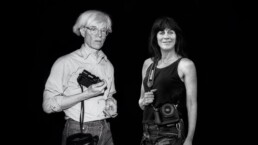
The Supreme Court decided today that the late Andy Warhol infringed upon the rights of photographer Lynn Goldsmith when he used her photograph of music legend Prince to create a silkscreen rendering of the late artist. The Court agreed with Goldsmith that Warhol’s use was not permitted under the copyright doctrine of Fair Use, which allows the use of a copyrighted work without the creator’s permission under certain circumstances.
“Today’s decision ensures the vitality of the Fair Use doctrine while protecting artists, particularly marginalized and developing artists, from the distortion of the doctrine into a tool for the misappropriation of one artist’s work by another artist with greater fame and public recognition,” said Lateef Mtima, Director of the Institute for Intellectual Property and Social Justice. “Elite patrons of the arts often gravitate to the work of famous artists, and in many situations are ignorant of the predecessor works produced by marginalized and lesser-known artists and which have been unfairly misappropriated by artists of renown. The Institute filed an amicus brief in support of photographer Goldsmith to support the proper application of the Fair Use doctrine as a critical tool to promote learning through and creative building upon artistic and literary achievement, while respecting the legitimate ownerships rights and artistic interests of creators in their work.”
The Supreme Court’s decision can be found here.
The Institute for Intellectual Property and Social Justice works to promote social justice in the field of intellectual property law and practice, both domestically and globally. Advocating for core principles of socially equitable access, inclusion, and empowerment throughout the IP ecosystem, IIPSJ’s work ranges broadly and includes scholarly examination of IP law from a social justice perspective; advocacy for social justice cognizance in the shaping and implementation of IP legislation and policy; initiatives to increase the diversity of the IP bar; and programs which promote greater awareness and understanding of IP protection, particularly among historically and currently disadvantaged and underserved groups, to empower them to exploit intellectual property effectively.

Wikimedia Highlights WRKE Fellow Contributions in Inaugural Year Review
Interested in learning about the “Why?” behind the Race and Knowledge Equity Fellowship program? Our partners at Wikimedia published a great piece on the Equity Fund where current IIPSJ fellow, Shreyanka Mirchandani Changaroth also received a special mention and quote:
IIPSJ’s inaugural Wikimedia Race and Knowledge Equity Fellow is Shreyanka Mirchandani Changaroth, a legal expert who has lived and worked in Singapore, Canada, and the United Kingdom, and is called to the Singapore bar. Shreyanka will lead work with IIPSJ to explore ways to impact IP policy in the US through community engagement. “We can now focus our efforts on tackling grassroots community education around intellectual property, something that goes to the very core of racial equity in the technological society,” said Shreyanka, when describing the new Fellowship.
Read their full article below.


[CLOSED 8/11/23] Applications Now Open: 2023-24 Wikimedia Race and Knowledge Equity Fellow
The inaugural year for the Wikimedia Race and Knowledge Equity (WRKE) Fellowship has been in a success. Now, thanks to continued generous support from our partners at the Wikimedia Foundation Knowledge Equity Fund, IIPSJ is pleased to announce that we are currently accepting applications to hire a new WRKE Fellow for the 2023-2024 year. You can view and download the full position announcement here.
Also in the coming weeks, be on the look out for resulting fellowship research and scholarship materials from our current fellow, Shreyanka Mirchandani Changaroth.
Questions and concerns may be directed to Tashia Bunch at Tashia.bunch@iipsj.org.