Blog Post: IIPSJ Attendance at the 68th Session of the General Assembly of the World Intellectual Property Organization
(WIPO GA) (Geneva, hybrid, 7-15 July 2026)
By Dr. Metka Potočnik (she/her/hers), Senior Lecturer in Law, Wolverhampton Law School
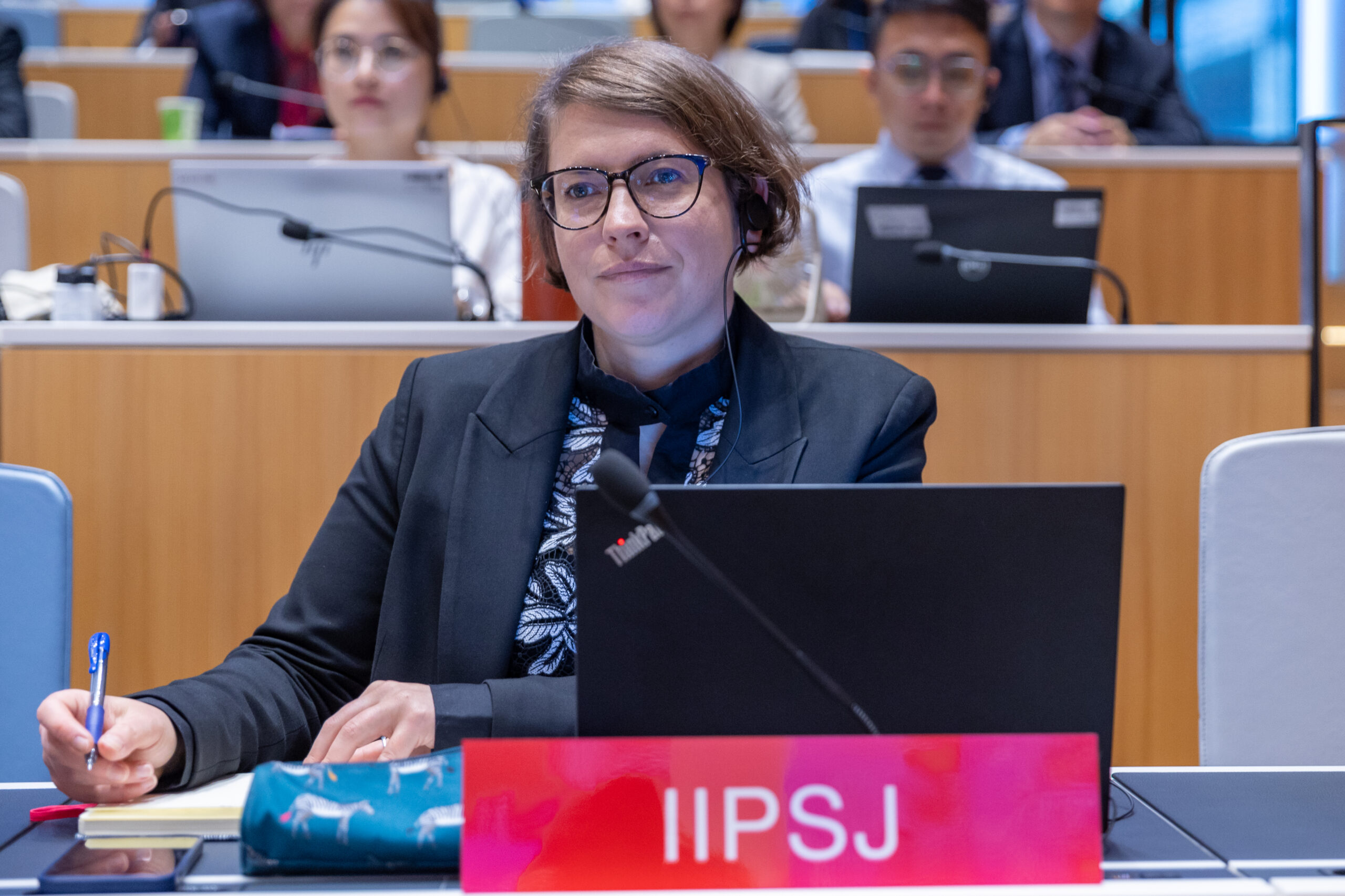
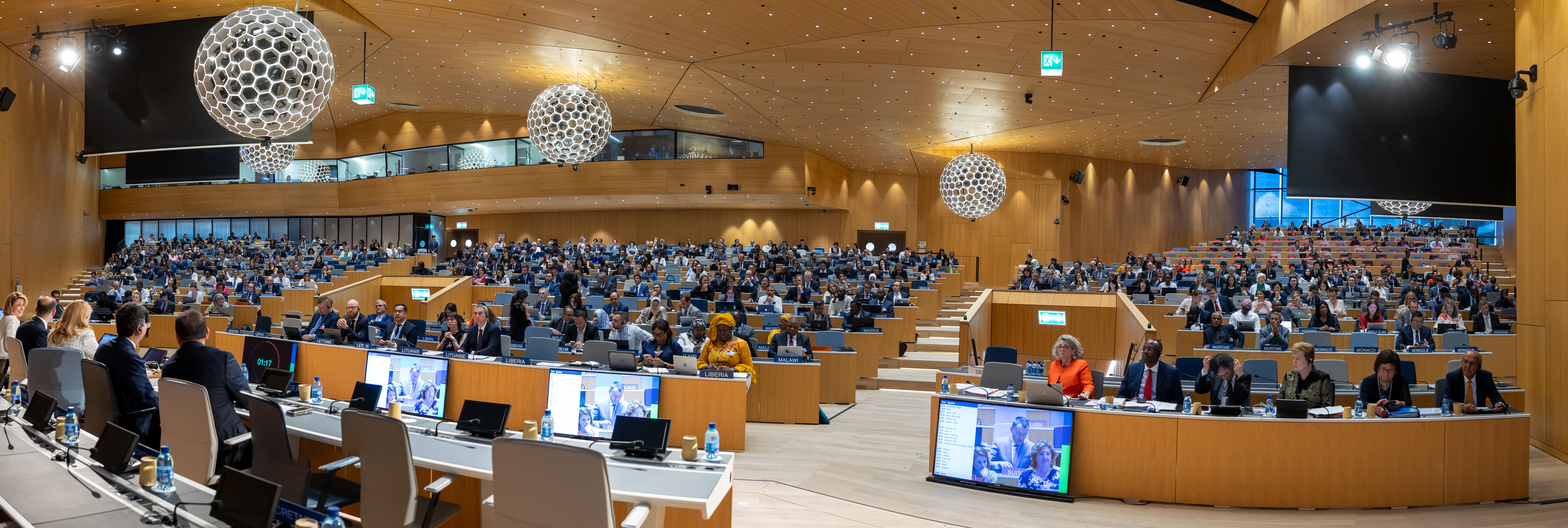
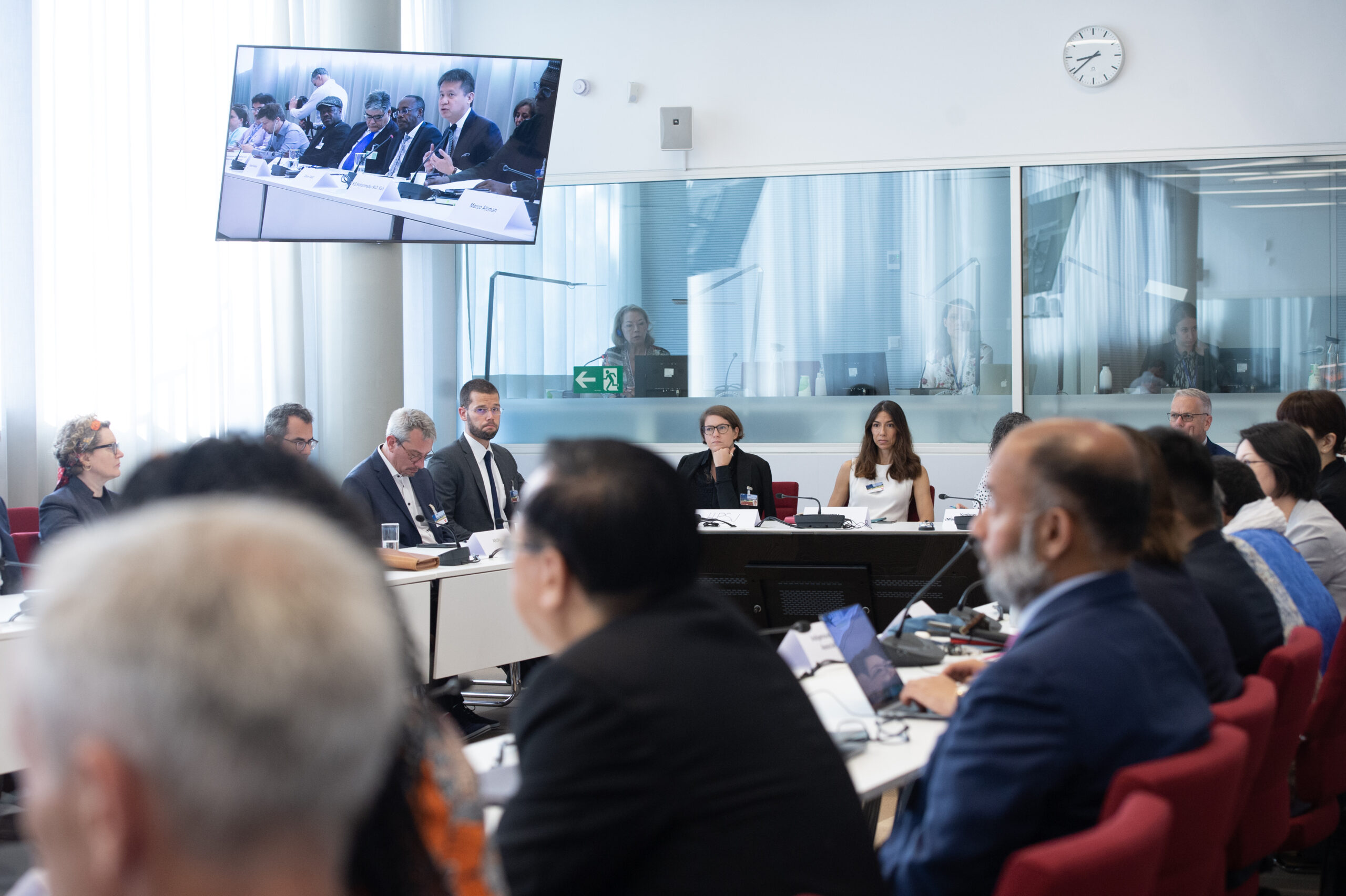
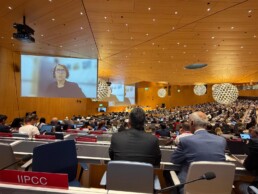
IIPSJ attended the 68th World Intellectual Property Organization (WIPO) General Assemblies (GA), in their capacity as the WIPO Accredited Observer. This year online, IIPSJ participated in the official hearings at the WIPO Headquarters in Geneva, with the Associate Director for International Programmes, Dr Metka Potočnik, attending the length of the proceedings. These assemblies brought together another record number of delegates from Member States, and Accredited Observers. All documents (see here) and sessions are available for viewing (see here). The opening address of the Director General Tang can be read in full, here. We heard that World IP Day in 2027 will be dedicated to IP and Fashion, with the 2026 celebrations dedicated to IP and Sports.
IIPSJ attended the GA sessions this year online. IIPSJ continues to take the GA meetings as an opportunity to build strategic partnerships with Member States and other stakeholders, interested in creating access, inclusion and empowerment for under-represented creators and innovators in the global eco-system. IIPSJ contributed to the discussion in writing (contact us for the full statement, which will be included in the GA report), and in the session, with Dr Potočnik making an oral statement under Agenda #4 on Wednesday, 8 July 2026, in the afternoon session (for the Chair’s introduction, view here, at 14:54:59, and for the statement, view here, at 14:55:17).
With much of the conversation directed at new technologies and generative AI, it was encouraging to witness DG Tang’s commitment to “…keeping the human spirit of innovation and creativity alive.” WIPO launched its Artificial Intelligence Infrastructure Interchange (AIII Initiative) on 17 March 2026, and according to WIPO “As AI systems operate across sectors and borders, existing infrastructure — often developed for specific uses in different industries — faces new challenges. But effectively deployed infrastructure also presents an opportunity to chart a path forward through those challenges, as it has for prior disruptions of the intellectual property system. AIII is a neutral panel on AI for creators, rights-holders, developers, and other experts to exchange ideas and explore practical solutions.” As highlighted in our statement, IIPSJ welcomes WIPO’s work on gender equality in IP systems, but we agree with several Member States that more needs to be done, including among the senior leadership at WIPO. Furthermore, we also call for more institutional dialogue, with organizations commanding specialist knowledge, such as The UN Commission on Status of Women (CSW), which is “the principal global intergovernmental body exclusively dedicated to the promotion of gender equality, the rights and the empowerment of women. A functional commission of the Economic and Social Council (ECOSOC), it was established by ECOSOC resolution 11(II) of 21 June 1946.”
During this GA session, many Member States also alluded to the upcoming 20-year anniversary of the Development Agenda in 2027 and WIPO’s work at the Committee on Development and IP (CDIP). The discussion saw a range of priorities among Member States, with several calling for CDIP’s programmes and expertise to be more mainstreamed, while a few Member States did not support this, and argued that other committees, especially the Standing Committee on Copyright and Related Rights (SCCR) and Standing Committee on the Law of Patents (SPC), must focus on the promotion and protection of IP only. There was a distinct disagreement between the place of discussions around Traditional Knowledge and Genetic Resources, and whether these should be confined to Intergovernmental Committee (IGC), or not. For IIPSJ recent participation at IGC, see here. While the WIPO Treaty on Intellectual Property, Genetic Resources and Associated Traditional Knowledge was adopted on 24 May 2024, it is not yet in force, and many Member States want to progress the work in the area, through conversations in SPC, and the Advisory Committee on Enforcement (ACE).
IIPSJ is continues to contribute to future discussions in WIPO, with the aim of building a more inclusive WIPO eco-system. The IIPSJ team are working towards a meaningful participation across all WIPO’s committees, especially SCCR, CDIP, ACE and IGC. If you are interested in contributing to IIPSJ work in this space, do contact the IIPSJ directly.

Blog Post: IIPSJ Attendance at the 52nd WIPO Intergovernmental Committee on Intellectual Property and Genetic Resources, Traditional Knowledge and Folklore (IGC)
(March 4 – 13, 2026, Geneva Switzerland)
By Dalindyebo Shabalala, Academic Co-Director and Professor of Law, Suffolk IP Center
Executive Summary
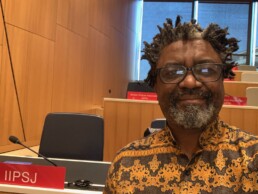
IIPSJ attended the 52nd session of the WIPO Intergovernmental Committee on Intellectual Property and Genetic Resources, Traditional Knowledge and Folklore in March 2026. Represented by Prof. Dalindyebo Shabalala (Suffolk Law IP Center), this was the next step in IIPSJ’s engagement at WIPO, expanding the work already being done by Dr. Metka Potocnik in the WIPO Standing Committee on Copyright and Related Rights (SCCR) and the WIPO General Assemblies (see https://iipsj.org/programs/iipsj-international/).
After the long in gestation success of the WIPO Treaty on Genetic Resources and Traditional Knowledge (see https://www.wipo.int/en/web/traditional-knowledge/wipo-treaty-on-ip-gr-and-associated-tk) this session was the first after a difficult negotiation for renewal of the mandate of the IGC at the WIPO IGC in June 2025 and the WIPO General Assemblies in July 2025. That mandate for 2026-27, asked that
“The Committee will, during the budgetary biennium 2026/2027, in a Member
State driven process, continue its work on the protection of genetic resources (GRs),
traditional knowledge (TK) and traditional cultural expressions (TCEs), with the
objective of finalizing an agreement on an international legal instrument(s), without
prejudging the nature of outcome(s), relating to intellectual property, which will
ensure the balanced and effective protection of TK and TCEs”
The question of the mandate came up as an issue quite quickly, in the structure of the agenda. The session began with Information sessions for the first three days rather than heading straight into text-based discussions, something which was noted by the African Group. While such Information sessions are always interesting, they represent a much earlier phase of the IGC negotiations where evidence gathering and sharing of experiences helped create an evidence base and persuaded member countries of the need for action. There were real concerns that this was an attempt to take a step back rather than build on the success of the WIPO GRATK Treaty. However, the need for a transition was also evident in that the IGC was being led by a new Chair and Vice-Chair as well as new leadership in the Secretariat. This may explain the somewhat slow start e.g. the fully proposed method of work for the session was not sent to all delegations until the first Friday of the session, three days in. However, the US delegation also saw fit to make a proposal for a survey questionnaire to “ascertain the operational aspects of sui generis systems in existence for the protection of TK and TCEs”. This was a relatively transparent effort to use further study to delay taking the next step into treaty text negotiations. IIPSJ provided an analysis and supported other civil society delegations in their response (see Blog Post). This was understood as a delaying tactic rather than a genuine attempt to seek evidence and information. There is already plenty of evidence of countries’ laws and case studies describing what countries are doing to protect traditional knowledge and traditional cultural expressions. It was opposed by most countries but there was a danger that it would provide an excuse for other delegations such as the EU to delay their commitment to moving forward with negotiations. In the end the proposal was not adopted and it was postponed for discussion at the next session.
Much of the discussion in the second week was held in non-recorded informal session, available via audio to civil society organizations but with participation of the Indigenous Caucus. The discussions went directly into text-based discussions on the draft texts for the protection of traditional knowledge and traditional cultural expressions. The most reassuring element of these relatively early discussions is how much expertise was apparent on the part of the participants and how much goodwill and support the Chair received. This bodes well for the nature and tone of future discussions.
In terms of outcomes (https://www.wipo.int/edocs/mdocs/tk/en/wipo_grtkf_ic_52/wipo_grtkf_ic_52_7.pdf) there were few of any note. Notably:
“The Committee worked, including text-based negotiations, on the basis of documents WIPO/GRTKF/IC/52/4 and WIPO/GRTKF/IC/52/5 and decided to continue this work on the basis of these documents at its next session.”
IIPSJ will be attending the next session to work with and support partner organizations.
Full Report
IIPSJ attended the 52nd session of the WIPO Intergovernmental Committee on Intellectual Property and Genetic Resources, Traditional Knowledge and Folklore in March. Represented by Prof. Dalindyebo Shabalala (Suffolk Law IP Center), this was the next step in IIPSJ’s engagement at WIPO, expanding the work already being done by Dr. Metka Potocnik in the WIPO Standing Committee on Copyright and Related Rights (SCCR) and the WIPO General Assemblies (see https://iipsj.org/programs/iipsj-international/).
After the long in gestation success of the WIPO Treaty on Genetic Resources and Traditional Knowledge (see https://www.wipo.int/en/web/traditional-knowledge/wipo-treaty-on-ip-gr-and-associated-tk) this session was the first after a difficult negotiation for renewal of the mandate of the IGC at the WIPO IGC in June 2025 and the WIPO General Assemblies in July 2025. That mandate for 2026-27, asked that
“The Committee will, during the budgetary biennium 2026/2027, in a Member
State driven process, continue its work on the protection of genetic resources (GRs),
traditional knowledge (TK) and traditional cultural expressions (TCEs), with the
objective of finalizing an agreement on an international legal instrument(s), without
prejudging the nature of outcome(s), relating to intellectual property, which will
ensure the balanced and effective protection of TK and TCEs”
The question of the mandate came up as an issue quite quickly, in the structure of the agenda. The session began with Information sessions for the first three days rather than heading straight into text based discussions something which was noted by the African Group. While such Information sessions are always interesting, they represent a much earlier phase of the IGC negotiations where evidence gathering and sharing of experiences helped create an evidence base and persuaded member countries of the need for action. There were real concerns that this was an attempt to take a step back rather than build on the success of the WIPO GRATK Treaty. However, the need for a transition was also evident in that the IGC was being led by a new Chair and Vice-Chair as well as new leadership in the Secretariat. This may explain the somewhat slow start and we can see this in that the fully proposed method of work for the session was not sent to all delegations until the first Friday of the session, three days in. However, the US delegation also saw fit to make a proposal for a survey questionnaire to “ascertain the operational aspects of sui generis systems in existence for the protection of TK and TCEs”. This was a relatively transparent effort to use further study to delay taking the next step into treaty text negotiations. IIPSJ provided an analysis and supported other civil society delegations in their response. (see Annex I). This was understood as a delaying tactic rather than a genuine plan to seek for evidence and information. There is already plenty of evidence of countries’ laws and case studies describing what countries are doing to protect traditional knowledge and traditional cultural expressions. It was opposed by most countries but there was a danger that it would provide an excuse for other delegations such as the EU to delay their commitment to moving forward with negotiations. In the end the proposal was not adopted and it was postponed for discussion at the next session.
Much of the discussion in the second week was held in non-recorded informal session, available via audio to civil society organizations but with participation of the Indigenous Caucus. The discussions went directly into text based discussions on the draft texts for the protection of traditional knowledge and traditional cultural expressions. The most reassuring element of these relatively early discussions is how much expertise was apparent on the part of the participants and how much goodwill and support the Chair received. This bodes well for the nature and tone of future discussions.
The Chair’s note’s following the IGC (https://www.wipo.int/edocs/mdocs/tk/en/wipo_grtkf_ic_52/wipo_grtkf_ic_52_www_657746.pdf) pointed out that informal discussions focused on:
1. Beneficiaries – who are the beneficiaries of the instrument(s) and how can we define them to provide legal certainty while allowing for adaptability at national levels? (Article 4 in both texts);
2. Eligibility criteria – what is the knowledge or cultural expression(s) that is covered by the instrument(s) and how can we define this to provide legal certainty while allowing for breadth of applicability at national levels? (Article 3 in both texts);
3. Objectives – why is the instrument(s) necessary and how does it conceptualise the interaction with other instruments/systems? (Article 2 in both texts); and
4. Scope – how is the knowledge or cultural expression(s) recognized and through what mechanisms? (Article 5 in both texts).
The Chair’s note provides an extensive assessment of the informal negotiations and where he sees significant opportunities for convergence/agreement and reconciling different concerns. On future work the Chair noted the following issues he thought member states should address before the next session:
Beneficiaries
1. Can the Committee:
• Taking note of the separate article(s) on the administration of rights/interests, outline a concept of whom ‘other beneficiaries’ are intended to be?
• Provide textual proposals outlining this concept of ‘other beneficiaries’, while providing Member States with sufficient flexibility to apply it in their national circumstances?
• Find a textual solution to address the remaining need around the term Indigenous Peoples and Local Communities?
Eligibility Criteria
2. Can the Committee:
• Carefully acknowledging differences, consider the questions (within their context above):
o How can we describe the difference between a legitimate innovation that is created by and belongs to an individual who is from an Indigenous People or Local Community, as opposed to an innovation by that same person that belongs to the Indigenous People or Local Community?
o How can we ensure that as Indigenous Peoples and Local Communities continue to develop cultural expressions and knowledge that they, as the holders, are able to determine how and when they are used within 50 years?
• Discuss examples around why there is a need to be able to add further criteria for protection at a national level?
Objectives
3. Can the Committee:
• Following an ‘Evidence-based Sharing Session’, develop a deeper conceptual understanding of the positive protection of traditional knowledge and traditional cultural expressions. With this, determine if there is a need for textual fine tuning of the positive protection within the objective article(s)?
• Within the defensive protection objective, identify and agree on a technical or general term to replace or add to the “erroneous grant of intellectual property rights” to broaden its meaning to intellectual property rights that are not ‘granted’.
• Move any text relating to ‘direct outcomes’ of the instrument(s) to the Preamble, at this time, or in the future.
Scope of Protection
4. Can the Committee:
• Further explore ways to conceptualise the relationship between measures and rights-based approaches, noting the existing role of the tiered approach.
• Develop choices for the Committee that are less binary in nature to create more negotiating room relating to scope of protection.
• Consider and amend the terminology ‘safeguard’ in Article 5 of both texts.
The Chair has made a good beginning and has appropriately outlined some key next steps. By focusing parties on specific pieces of work, the Chair pushes past the basic question of whether to negotiate in the first place. However, the issues he has identified are also some of the most difficult and contentious and are not likely to be resolved at the next session, let alone by the next biennium. By the end of the next meeting the Chair should present a vision of what needs to be accomplished in terms of progress to present at the next renewal of the mandate.
In terms of outcomes (https://www.wipo.int/edocs/mdocs/tk/en/wipo_grtkf_ic_52/wipo_grtkf_ic_52_7.pdf) there were few of any note. Notably:
“The Committee worked, including text-based negotiations, on the basis of documents WIPO/GRTKF/IC/52/4 and WIPO/GRTKF/IC/52/5 and decided to continue this work on the basis of these documents at its next session.”
The work of this next phase of international work on the protection of traditional knowledge and traditional cultural expressions. The hurdle of whether or not to seek further outcomes and protections has been overcome. The hope is that it will not take another 25 years to come to another outcome on these issues.
Annex I
Analytical Note on the US Proposal for a “Questionnaire on the use of sui generis protections for Traditional Knowledge and Traditional Cultural Expressions, a Summary Report of responses received, and a Presentation of results (WIPO/GRTKF/IC/52/6)”
Top Line Summary
1. If the US believes it needs further information to inform its own actions it should proceed and generate that information itself.
2. The proposal from the US is vague and over-broad and is not technically capable of being completed accurately within the time frame proposed.
3. Other norm-setting processes at WIPO have not been subjected to the same standard of evidence or proof being proposed by the US, and the main issue, establishing the existence of the misappropriation problem, has already been done.
4. The purpose of the proposal is to delay progress on text-based negotiations and will have that effect if adopted, whatever the best intentions of some countries.
I. Introduction
The US has made a proposal for further study to enable ‘evidence- based’ decision-making in moving forward on the treaty texts. While the renewed mandate leaves the door open for further studies, it states that such studies should NOT prevent or delay progress on text-based negotiations. As a matter of realpolitik, the US opposes moving forward on the text-based negotiations. Its proposal would likely have that effect as the US would seek to refer to the study as necessary to be presented before it could commit to further action. The US has made it clear that it believes that the IGC should take a pause to determine the necessity of continuing the work of the committee. While the US is willing to say this somewhat more bluntly, this is something that its partners in Group B may be less willing to state in the same way. This may explain why the US is putting this proposal forward at this time, knowing that it is likely to be opposed by the majority of countries but especially the African group. However, the proposal does enable the US to provide cover and a means for other Group B members, if they so wish, to support further study, with an implied understanding that it will be a means of asking for delays at a later date, to wait for results before moving forward on stronger action. It may therefore be a means by which Group B can maintain some cohesion with the US in the next two sessions. The response then should be aimed at eroding the ability of other Group B members, especially the EU, to use the US proposal as cover. A response should be aimed at weakening the apparent reasonableness and rationality of the proposal such that it is less able to serve as cover and with that in mind, the following potential criticisms can be put forward by member states, indigenous representatives and civil society organizations.
II. Analysis
The United States has made a proposal that it believes there is relevant missing information to inform its positions in the negotiations in the WIPO IGC. The proposal would involve a survey that places a further unplanned and unfunded burden on the secretariat and other member states to generate that information on its behalf. This requires additional financial resources and personnel on the part of the secretariat AND on the part of other member states. Given that there is some gap between member states as to whether such purported information is even required or whether it is actually unavailable, it would seem that the initial burden for showing that such a gap exists should fall on the US. If it believes that such a gap needs to be filled it may be appropriate to expend its own very considerable financial, technical and personnel resources to support such research and surveys. This work can be carried out through institutions such as Fulbright Scholarships, National Science Foundation, National Endowment for the Humanities Funding and Fellowships, Department of State, USAID etc.
Of additional concern is the sheer breadth of the survey.
“instances of compliance with requirements under such systems (e.g., registration of TK and TCEs, recordation of agreements, government approvals), information on the number and details of any adjudications or enforcement outcomes or other forms of dispute resolution occurring under these systems, concrete outcomes delivered by the systems (for TK and TCE holders, governments, interested third parties, and society at large (including commercialization of TK or TCEs)), and financial sustainability (including the costs of administering the systems versus economic benefits generated (e.g., royalties)). “
It presents a methodological challenge requiring capabilities not present in the Secretariat nor necessarily in any particular consultant or set of consultants. The information is not simply available in existing databases or documents but would have to actually be generated as part of the study. The stakeholders who would need to be surveyed at the national level differ immensely and would require significant resources to reach. In each specific area:
1. “registration of TK and TCEs, recordation of agreements, government approvals” – such information is likely in the hands of multiple government agencies not just a specific department of TK and TCEs. The coordination process for generating and identifying such information is extensive. This is a significant study all by itself.
2. “information on the number and details of any adjudications or enforcement outcomes or other forms of dispute resolution occurring under these systems” – this would require ensuring that the universe of cases be identified in the courts of first instance, if at all, as well as in other dispute mechanisms, such as customary courts. The cases would have to be reported and published, and have received some type of final adjudication. This would be separate from other dispute settlement mechanisms such as arbitration, which may or may not be published, as well as decisions and dispute settled by regulatory bodies. This, again, is a significant study all by itself, likely lasting at least 2 years in any specific jurisdiction. For example, in the United States, simply gathering the universe of cases especially in tribal jurisdictions would be an extensive task. This would require assessing and summarizing each case for its outcomes, characterizing it as falling into specific categories and then analyzing the structure of the outcomes, among other things. This would likely entail thousands of cases, and the data would likely be incomplete because of the lack of reported cases in US tribal jurisdictions. One can imagine how much more difficult such research would be in other countries with far less resources and structured case reporting systems. A rushed study is likely to generate something that looks like data but will have little statistical validity.
3. “concrete outcomes delivered by the systems (for TK and TCE holders, governments, interested third parties, and society at large (including commercialization of TK or TCEs))” – this is the most vague component of the proposal. Even before attempting to make causal links between legislative changes and broad societal outcomes, there are serious difficulties in defining what the metrics to be measured would be. Experience suggests that conducting such economic studies related to legislative policy changes have taken multiple years and have not always been able to generate useful information. For example, the EU studies on the impact of the Database Directive study which looked JUST at whether the directive resulted in growth of the database industry in the EU took a long time to carry out and still found it difficult to generate highly reliable results and information.
As a matter of research design, the question at the broad level that the US is seeking is better addressed through case or country studies to generate comparative information and in-depth answers that can point to causal relationships. These take time and require significant time on the ground. Once those studies are presented then specific questions about each causal link can form the basis for further analysis. However, this cannot be the basis for determining the necessity for an international treaty. WIPO treaties are formulated to address specific problems, and the WIPO IGC was formed in response to the well documented problem of misappropriation of traditional knowledge and traditional cultural expressions and these text-based discussions are built in response to that problem. Such solutions are always prospective as they specifically address cross-border problems, NOT whether specific suites of policies of rights and duties are appropriate at the national level. When WIPO agreed on the Lisbon Agreement and its Geneva Act, this was not the required standard for coming to agreement. In fact, in contrast to the over-broad and vague proposal here, the US has recently (February 2026) made a proposal in the Standing Committee on the Law of Trademarks, Industrial Designs and Geographical Indications (SCT/49/6 – https://www.wipo.int/edocs/mdocs/sct/en/sct_49/sct_49_6.pdf), that asks a very specific set of questions in a questionnaire on the legal, administrative, and procedural aspects of examination and registration of certification marks. The US knows how to ask specific questions that are capable of being answered by countries within the framework of WIPO capacities and that can generate information with statistical significance and validity. The danger of the proposal is that it
1. demands evidence
2. designs review and studies that cannot actually find the relevant evidence
3. cite absence of evidence as justification for delaying action

Blog Post: IIPSJ Attendance at the Extraordinary 67th Session of the General Assembly of the World Intellectual Property Organization
(WIPO GA) (Geneva, hybrid, 21 April 2026)
By Dr. Metka Potočnik (she/her/hers), Senior Lecturer in Law, Wolverhampton Law School
IIPSJ attended the extraordinary 67th World Intellectual Property Organization (WIPO) General Assemblies (GA), in their capacity as the WIPO Accredited Observer. In our fourth year of continuous
attendance, IIPSJ participated in the official hearings at the WIPO Headquarters in Geneva, with the Associate Director for International Programmes, Dr Metka Potočnik, attending the length of the proceedings online. The aim of the extraordinary session was to agree the future leadership of the organization, the re-appointment of, and terms of employment of Director General Tang. This followed the nomination of DG Tang for the position by the Coordination Committee in its 29th Extraordinary Session between 12 to 13 February 2026. The reappointment is for another six years
and begins on 1 October 2026.
In his address, DG Tang briefly took stock of the organization’s key achievements since he took office on 1 October 2020, of which there were several and include also two new, international treaties,
agreed by WIPO Member States by consensus (Treaty on Intellectual Property, Genetic Resources and Associated Traditional Knowledge; and Riyadh Design Law Treaty). Looking forward, WIPO needs to be at the forefront of technological, digital and AI innovation, while not forgetting about the “human touch.” It is also worth noting that DG Tang sees IP as an issue, that should cross streams from specialist areas, to mainstream, where “we will need to aspire for IP to become mainstream, not just as policy priorities for governments and leaders but as something recognized and valued by people everywhere, that when someone talks about technology, brands, designs, art, culture, sports, agriculture, trade, economy, finance and our world, they are aware that IP plays an important role in all of these.”
His address was received warmly by all in attendance, while several WIPO Member States noting that much work remains to be done, in the current oft challenging circumstances.
IIPSJ is continues to contribute to future discussions in WIPO, with the aim of building a more inclusive WIPO eco-system. The IIPSJ team are working towards a meaningful participation the regular, 68th WIPO General Assembly, which is taking place in Geneva (hybrid), between 7 to 15 July 2026. If you are interested in contributing to IIPSJ work in this space, do contact the IIPSJ directly.
Blog Post: IIPSJ Attendance at the 66th World Intellectual Property Organization General Assemblies
(WIPO GA) (Geneva, 8-17 July 2025)
By Dr. Metka Potočnik (she/her/hers), Senior Lecturer in Law, Wolverhampton Law School
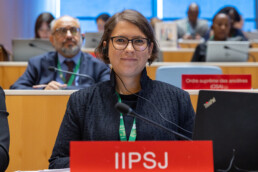
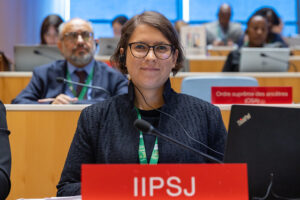
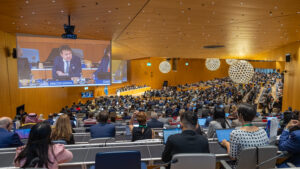
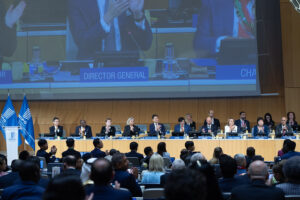
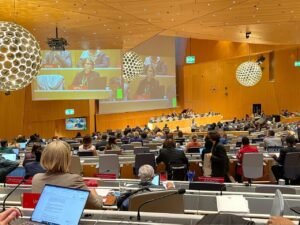
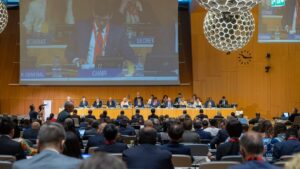
IIPSJ attended the 66th World Intellectual Property Organization (WIPO) General Assemblies (GA), in their capacity as the WIPO Accredited Observer. Now attending in person for the third year in a row, IIPSJ participated in the official hearings at the WIPO Headquarters in Geneva, with the Associate Director for International Programmes, Dr Metka Potočnik, attending the length of the proceedings in person. These assemblies brought together another record number of delegates (over 1,600), from 194 Member States. All sessions are available for viewing here. The opening address of the Director General Tang, can be found here.
IIPSJ attended the GA sessions for the third time in Geneva, after having observed several WIPO meetings online, since 2020. IIPSJ continues to take the GA meetings as an opportunity to build strategic partnerships with Member States and other stakeholders, interested in creating access, inclusion and empowerment for under-represented creators and innovators in the global eco-system. IIPSJ contributed to the discussion in writing (contact us for the full statement, which will be included in the GA report), and in the session (view here, at 00:43:51, or here).
The content of our statement, in particular our emphasis of the UN Sustainable Development Goals, was also reflected in the discussions among Member States during the Programme and Budget Committee. What we have seen since the beginning of 2025 is a change in the context of discussions at WIPO, especially Agenda #11 (see here). Among other proposals, the United States asked for the “Removal of all references to the 2030 Agenda for Sustainable Development and SDGs from the Proposed Program of Work and Budget for 2026/2027” (A/66/7, page 11, Agenda #9, paragraph 3(i), see here), together with a reduction, or deletion of the Development Acceleration Fund. After two weeks of informal negotiations, all Member States approved the PBC on Thursday, 17 July 2025 (final day), without the deletion of the UN SDGs from the Proposed Program of Work and Budget for the upcoming biennial. The US delegation did not want to stand in the way of adopting the PBC by consensus but put their strong objections to WIPO’s continued references to the implementation of the UN SDGs, across their work and programmes on the record.
IIPSJ representative, Dr Metka Potočnik, also attended the 12th WIPO-NGO Stakeholder Dialogue, which was organised in parallel with the 66th WIPO GA and took place on Friday, 11 July 2025, at the WIPO New Building. WIPO Director General Darren Tang, Assistant Director Edward Kwakwa and Assistant Director General Andrew Staines, and other WIPO experts met with sixty-eight Accredited Observers and NGOs “to exchange views and strengthen engagement with the global intellectual property (IP) system.” According to DG Tang, when counting the Observers as well, the number rises to 1,800 delegates of the 66th GA session. The event has been placed in the spotlight for its importance and more can be read here.
WIPO also launched its Institutional Capacity Framework (ICF), which will be ‘a health check tool’ for universities and research institutions, aimed at fostering innovation. ADG Marco Aleman acknowledged that universities and research institutions are environments where innovation happens. Research organisations will be able to use ICF (on voluntary basis) to create growth, facilitate policymaking and build dialogue. Professor Fazilet Vardar introduced the ICF in more detail. ICF combines Knowledge and Technology (K/TT) Metrics to assess seven core capability dimensions: (1) leadership and governance, (2) organisational capacity, (3) institutional culture, (4) infrastructure, (5) transfer mechanisms, (6) stakeholder engagement, and (7) monitoring and learning. The tool will be general in nature and include research from all fields (STEM, social sciences, or the arts) and aims to cover the needs from organisations, which are only starting in research, and the needs of larger universities, well-established in world-leading research. The tool is still under development and its publication still pending. If you are with a research institution or a university and want to help WIPO develop the ICF (either at the stage of proof of concept by the end of 2025, or in the pilot stage, taking place in early 2026), please do get in touch with us, and we will connect you with the relevant WIPO team.
IIPSJ is continues to contribute to future discussions in WIPO, with the aim of building a more inclusive WIPO eco-system. The IIPSJ team are working towards a meaningful participation in the 47th Session of the Standing Committee on Copyright and Related Rights (SCCRR) (see here, 2026 dates to be confirmed) and the 35th Session of the Committee on Development and Intellectual Property (CDIP) (see here). Going forward, the IIPSJ also plans to expand its activities to the work of the Advisory Committee on Enforcement (ACE) (see here), in particular in the field of IP arbitration and mediation. If you are interested in contributing to IIPSJ work in this space, do contact the IIPSJ directly.

Blog Post: IIPSJ Attendance at the 65th World Intellectual Property Organization General Assemblies
(WIPO GA) (Geneva, 9-17 July 2024)
By Dr. Metka Potočnik (she/her/hers), Senior Lecturer in Law, Wolverhampton Law School
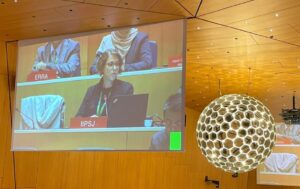
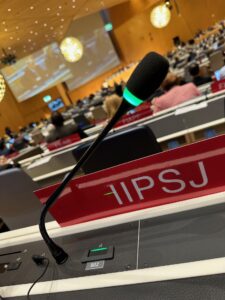
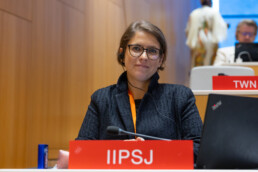
IIPSJ attended the 65th World Intellectual Property Organization (WIPO) General Assemblies (GA),
in their capacity as the WIPO Accredited Observer. Now attending regularly, IIPSJ participated in the
official hearings at the WIPO Headquarters in Geneva, with the Associate Director for International
Programs, Dr. Metka Potočnik, attending the length of the proceedings in person. These
assemblies brought together another record number of delegates. A full list of participants is
available here, and all the sessions are available for viewing here.
IIPSJ attended the GA sessions for the second time in Geneva, after having observed several WIPO
meetings online, since 2020. IIPSJ continues to take the GA meetings as an opportunity to build
strategic partnerships with Member States and other stakeholders, interested in creating access,
inclusion and empowerment for under-represented creators and innovators in the global eco-
system. IIPSJ contributed to the discussion in writing (see here), and in the session (view here, at
02:31:12).
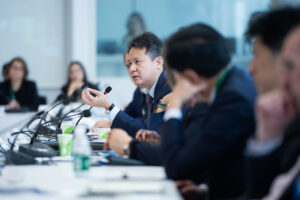
IIPSJ representative, Dr. Metka Potočnik, also attended the 11th WIPO-NGO Stakeholder Dialogue,
which was organised in parallel with the 65 th WIPO GA and took place on Thursday, 11 July 2024, at the WIPO New Building. WIPO Director General Tang, Deputy Director Edward Kwaka and other WIPO experts met with over sixty Accredited Observers and NGOs, in discussing global challenges, which require a multi-stakeholder response. IIPSJ sent their question in advance, and continued informal conversations with WIPO and several interested stakeholders for the duration of the GA meetings. The event has been placed in the spotlight for its importance, and more can be read here.
IIPSJ is continues to contribute to future discussions in WIPO, with the aim of building a more inclusive WIPO eco-system. The IIPSJ team are working towards a meaningful participation in the 46th Session of the Standing Committee on Copyright and Related Rights (SCCRR) (see here, 2025 dates to be confirmed) and the 33rd Session of the Committee on Development and Intellectual Property (CDIP) (see here). If you are interested in contributing to IIPSJ work in this space, do contact the IIPSJ directly.
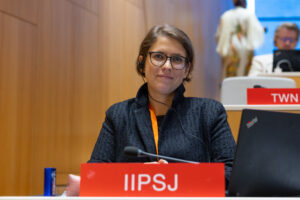


Blog Post: IIPSJ Oral Statement to WIPO
IIPSJ Oral Statement to the 65th World Intellectual Property Organization (WIPO) General Assemblies (GA)
July 9-17, 2024
Honorable Chair, Director General, distinguished Delegates, thank you for the floor.
Institute for IP and Social Justice stresses that IP systems must balance economic and
social aims equally, in a manner that offers access, inclusion, and empowerment for all.
WIPO’s IP Gender Action Plan should include initiatives designed to also address
intersectional discrimination and misogyny in the creative and innovative ecosystems. We
stress the need to move away from projects that prioritize only “getting more women into the
system.” Intersectional discrimination and misogyny are systemic barriers that must be
corrected. IP laws must form part of the solution.
Efforts to address intersectional discrimination must also be at the heart of data collection
projects. More should be done to develop methodologies for non-registrable IP rights
(mainly, copyright); and methodologies beyond the mere binary counting of genders, so that
we also include gender-diverse people.
For more, please see our written statement.
Prepared by Dr. Metka Potočnik
IIPSJ Associate Director for International Programs

Mosaic 2023 Event Recap
On October 27-28, 2023, IIPSJ, along with University of Illinois Chicago Law, hosted the 9th Annual IP Mosaic Conference with the theme IP Rights and Wrongs: Advancing Social Justice and Ethics.
During the conference, attendees were able to listen to two plenary panel presentations which are saved on our Youtube page. The presentations were:
International IP and Climate Change
Moderator: Metka Potočnik, Senior Lecturer in Law, University of Wolverhampton, Law School and Director of The F-List for Music CIC
Panelists:
- Peter Oksen, World Intellectual Property Organization, Global Challenges Division
- Antony Taubman, World Trade Organization, Intellectual Property Division
Copyright Behind Bars: At the Intersection of Systemic Incarceration and IP Social Justice
Moderator: John R. Whitman, Ph.D., author, Executive Director, Museum for Black Innovation and Entrepreneurship
Panelists:
- Jeanie Austin, Ph.D., Librarian, Jail and Reentry Services, San Francisco Public Library
- Wendy Jason, Founder and Director, Justice Arts Coalition, nonprofit national network for those creating art in and around the criminal justice system (invited)
- Doran Larson, Ph.D, Professor of Literature, Hamilton College and Founder and Co-Director of the American Prison Writing Archive
- Viva R. Moffat, Professor of Law, Co-Director, Intellectual Property and Technology Law Program, Sturm College of Law, University of Denver, advocating for IP rights for currently/formerly incarcerated and society
- Fury Young, Founder and Co-Executive Director, Die Jim Crow, the first nonprofit record label for currently and formerly incarcerated artists
In addition, participants were able to present their papers and ideas for papers and receive feedback from attendees on their ideas. These five separate paper presentation panels were:
- IP & Tech
- 2023 Ben Liu Scholars
- The Role of Patent Law: from Technicalities to Social Correctives?
- IP and Social Action: Ways to Empowerment?
- Music Creators and Society: System Reboot or Reform to Building Better Partnerships?
We hope you can join us this fall as we celebrate the 10th Annual IP Mosaic Conference at in person and online at Marquette University Law School (dates TBA).

Blog Post: IIPSJ Attendance at the 44th WIPO Standing Committee on Copyright and Related Rights (SCCR)
IIPSJ Attendance at the 44th World Intellectual Property Organization Standing Committee on Copyright and Related Rights (WIPO SCCR)
Geneva, 6-8 November 2023
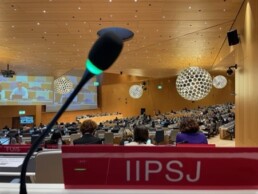
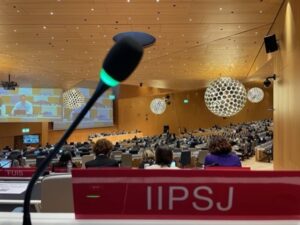
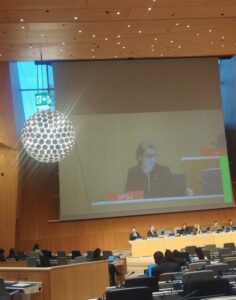
IIPSJ attended the 44th World Intellectual Property Organization (WIPO) Standing Committee on Copyright and Related Rights (SCCR), in their capacity as the WIPO Accredited Observer. IIPSJ submitted a written statement and attended the official hearings at the WIPO Headquarters in Geneva, with the Associate Director for International Programs, Dr. Metka Potočnik, attending the length of the proceedings in person. These assemblies brought together delegates from Member States in person, and online, and a significant number of observers. A full list of participants is available here, and all the sessions are available for viewing here.
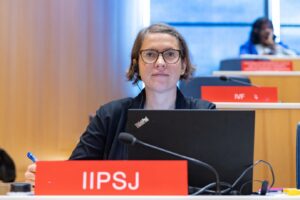
IIPSJ attended the WIPO General Assemblies in July 2023, and at this latest meeting continued to grow strategic partnerships with Member States and other stakeholders, interested in creating access, inclusion and empowerment for under-represented creators and innovators in the global eco-system. Delegates at the SCCR discussed the two standing issues (broadcasting and limitations and exceptions) and some other matters, such as copyright in the digital environment. Full agenda can be viewed here. On copyright in the digital environment IIPSJ representative offered an oral intervention, highlighting the need to align the work of the SCCR with the work WIPO has done in its Intellectual Property Gender Action Plan, which was adopted in 2023 (see here). Furthermore, Dr. Potočnik stressed that all research and evidence collection from artists and creators must be intersectional, focusing not only on all genders, but also race, class, age, (dis)ability of the creators, inclusive IP systems are meant to protect. The written statement can be viewed here (page 3), and the oral intervention is available here (at 02:41:17).
IIPSJ will contribute to future discussions in WIPO, with the aim of building more inclusive IP systems across different jurisdictions. The IIPSJ team are working towards a meaningful participation in the 31st Session of the Committee on Development and Intellectual Property (CDIP) (see here), whilst awaiting the confirmation of the 2024 schedule, where further work will be presented. If you are interested in contributing to IIPSJ work in this space, do contact the IIPSJ directly.
Blog Post: IIPSJ Written Statement Submitted to WIPO
IIPSJ Written Statement to the 44th Session of the WIPO Standing Committee on Copyright and Related Rights (SCCR)
November 6-8, 2023
IIPSJ is a WIPO Accredited Observer, seated in the United States, focused on matters domestically, and internationally. IIPSJ examines intellectual property laws and policies to see where full participation of disadvantaged, excluded, and marginalized groups may need redressing. IP systems should offer access, inclusion, and empowerment for all, not only a select group. At this time, we would like to add a few observations of general nature, to the 44th SCCRR Agenda Item Number 8.1 on the Proposal for Analysis of Copyright Related to the Digital Environment.
The digital environment offers both opportunities, and risks for the creatives, sharing their works online. Effective IP protection and exploitation must be considered against the interests of various groups of stakeholders. There is evidence across jurisdictions, that not all artists, creatives, or musicians, are making comparable income, and that some groups are marginalized by the IP systems. In 2021, the UK Intellectual Property Office conducted a survey, finding that women make from music seven thousand pounds less than men, who on average make twenty thousand pounds a year.i In 2022, a larger sample investigating the earnings by Black artists found, that on average, Black women make twenty-five percent less than white women.ii In 2023, evidence found that Black musicians with disabilities, have fewer opportunities in the sector still.iii
IIPSJ has an extensive network of scholars and sister organizations, who have explored the effects of IP systems on different groups of inventors and creatives, and they agree that the personal characteristics, such as gender(s), race, nationality, age, disability, class (or other), matter when it comes to access and enjoyment of IP systems (an intersectional approach). Making art, as making music, is a social activity, where conditions in which the individuals create, matter. WIPO’s commitment to an inclusive IP regime is demonstrated, among other, by its activities under “Intellectual Property, Gender and Diversity” and its current WIPO IP Gender Action Plan (IP GAP). IP GAP’s vision of gender equality will rely on research “to identify the scope and nature of the gender gap in IP and ways to close the gap”.iv IIPSJ would add to the action plan and stress that firstly, WIPO IP GAP commitments should be implemented in other WIPO Studies, Analysis, and Action Plans, across all Divisions (such as the here discussed Agenda #8.1), and secondly, that this research must be intersectional, to avoid any correctives which could continue to ignore artists, creatives, or musicians, who are currently disadvantaged, excluded and marginalized by the creative industries.
There cannot be a socially just approach towards building an inclusive IP system, if we focus ‘on gender alone,’ or operate under the assumption that the digital space is full of opportunities, equal to all. There is ample research to demonstrate that not all artists or creatives, have equal access or opportunities, to share their innovation and imagination with the world, to the mutual benefit of all in the society.
Prepared by Dr. Metka Potočnik
IIPSJ Associate Director for International Programs
i Intellectual Property Office, ‘Music creators’ earnings in the digital era’ (2021). Available: https://www.gov.uk/government/publications/music-creators-earnings-in-the-digital-era.
ii Black Lives in Music (BLIM UK), ‘Being Black in the UK Music Industry: Music Creators Part I’ (2021). Available: https://blim.org.uk/report/. For general research on women in UK music: Vick Bain, ‘Counting the Music Industry: the Gender Gap; A study of gender inequality in the UK Music Industry’ (2019). Available: https://vbain.co.uk/research/.
iii Black Lives in Music (BLIM UK), ‘Unseen. Unheard. Race and Disability – Black disabled experience in the UK’s music industry’ (2023). Available: https://blim.org.uk/report-unseen-unheard/.
iv World Intellectual Property Organization, ‘WIPO Intellectual Property (IP) and Gender Action Plan: the Role of IP in Support of Women and Girls’ (2022) 4. Available: https://www.wipo.int/women-and-ip/en/4.
IIPSJ Attendance at the 64th World Intellectual Property Organization General Assemblies
(WIPO GA) (Geneva, 6-14 July 2023)
By Dr. Metka Potočnik (she/her/hers), Senior Lecturer in Law, Wolverhampton Law School
IIPSJ attended the 64th World Intellectual Property Organization (WIPO) General Assemblies (GA), in their capacity as the WIPO Accredited Observer. IIPSJ attended the official hearings at the WIPO Headquarters in Geneva, with the Associate Director for International Programmes, Dr Metka Potočnik, attending the length of the proceedings in person. These assemblies brought together a record number of delegates, with over 1,200 delegates in attendance, which exceeded the pre-Covid numbers of attendance in the General Assemblies. A full list of participants is available here, and all the sessions are available for viewing here.
IIPSJ previously observed several WIPO meetings online and took this GA as an opportunity to create strategic partnerships with Member States and other stakeholders, interested in creating access, inclusion and empowerment for under-represented creators and innovators in the global eco-system. IIPSJ representative attended the 10th WIPO-NGO Stakeholder Dialogue, which was organised in parallel with the 64th WIPO GA and took place on Monday, 10 July 2023, at WIPO New Building. WIPO Director General Tang and other WIPO experts met with over 40 Accredited Observers and NGOs, in discussing important issues, which require a multi-stakeholder response. The event has been placed in the spotlight for its importance, and more can be read here.
IIPSJ is aiming to contribute to the future discussions in WIPO, with the aim of building a more inclusive WIPO eco-system. The IIPSJ team are working towards a meaningful participation in the 44th Session of the Standing Committee on Copyright and Related Rights (SCCRR) (see here) and the 31st Session of the Committee on Development and Intellectual Property (CDIP) (see here). If you are interested in contributing to IIPSJ work in this space, do contact the IIPSJ directly.