Update on H.R. 1695
Update on H.R. 1695: Should the Register of Copyrights Become a Political Appointee?
For those not familiar with the Register of Copyrights Selection and Accountability Act (H.R. 1695) this Legislative Bill would extinguish the authority of the Librarian of Congress to appoint the Register of Copyrights, a responsibility that the Librarian has held since 1870. There has been relatively little public discussion of the Bill – in fact it has already passed in the House of Representatives. If the Bill is passed by the Senate, the power to appoint and dismiss the Register would shift to the President.
Supporters of the Bill argue that removal of the Librarian’s appointment power is necessary to modernize the Copyright Office. Among the questions that have been raised by the Bill’s proposal, however, is how modernization of the Copyright Office would be aided by making the Register’s appointment a political process. Given the Constitutional directive that the primary function of copyright is to serve the national interest in promoting the progress of the arts and sciences, it seems reasonable to expect that the expert entrusted with curating the national repository of knowledge and culture would also be well-qualified to appoint a Register capable of serving the public interest in the modern administration of the copyright system.
The actual text of H.R. 1695 does not enumerate modernization of the Copyright Office as one of its objectives. Consequently some critics urge that the Bill is actually an effort to benefit the Content Industries at the public’s expense. “This bill serves no purpose other than to take power away from the Librarian of Congress and give it to powerful lobbyists, who will have a major say in who runs the Copyright Office,” writes Michael Masnick on TechDirt.com. “It’s…a gift to Hollywood.” Other critics argue that the Bill is a veiled attack on the current Librarian. According to Laura Burke of NewsOne Now, “President Barack Obama appointed [Dr. Carla] Hayden the 14th Librarian of Congress on February 24, 2016. She is the first African American to hold the position, as well as the first woman to be the Librarian of Congress….On March 23, legislation was introduced to block Hayden from appointing the next Register of Copyrights.”
Both supporters and opponents seem to agree that Dr. Hayden’s reassignment of former Register Maria Pallante, who subsequently resigned, is one issue at the heart of the controversy. In an article in The Hill, H.R 1695 supporters Dina LaPolt and John Meller write that “[T]he Librarian of Congress…is rarely … in tune with copyright issues…to put it mildly…. [L]ast year, without warning or justification, the Librarian fired Register Maria Pallante, long heralded as a fantastic Register and advocate for strong copyright protection.” While serving in her position, Register Pallante publicly expressed the view that “Copyright is for the author first and the nation second.”
Given the important public interest functions that both the Librarian and the Register embody in the copyright system, H.R. 1695 raises important issues of copyright social justice. Attached below is a link to the text of the Bill, as well as links to various commentaries in support of and in opposition to the proposed legislation.
We invite you to post comments and questions on our Facebook page.
IIPSJ
H.R. 1695 Bill Text
https://www.congress.gov/bill/115th-congress/house-bill/1695/text
Commentaries in support of H.R. 1695
Commentaries in opposition to H.R. 1695
http://shareblue.com/house-gop-seizes-power-from-first-black-female-librarian-of-congress/
http://www.blackpressusa.com/house-votes-to-limit-powers-of-first-black-librarian-of-congress/
Send an email to updates@iipsj.org with SUBSCRIBE in the subject line to receive these updates to your inbox.

Copyright Podcast
Copyright & Social Justice Podcast & Other Articles of Interest
1) IISPJ’s Director, Lateef Mtima, is a guest on the recent edition of the CopyThis podcast hosted by Kirby Ferguson and presented by the Re:Create Coalition. You can find the podcast along with a full description here on the Re:Create Coalition website. A portion of the description is reproduced below.
Copy This Podcast Episode 5: Copyright Drives the Beat of Social Justice
“…While many may think about copyright law in terms of music, books and movies and how to access them, Lateef Mtima, Professor of Law at the Howard University School of Law and Founder and Director of The Institute for Intellectual Property and Social Justice, points to the Constitution to remind listeners that copyright’s “most important function is to provide people with knowledge, to educate themselves… to share ideas and information.”…
From the Black Lives Matter movement, to the high profile “Blurred Lines” case that has pitted Robin Thicke and Pharrell Williams against Marvin Gaye’s estate, and even led to varying opinions across the full spectrum of the copyright community, Lateef helps bring to light copyright discussions that are playing out in communities and the courts in real time today so be sure to tune in.”
2) http://www.eifl.net/news/eifl-marrakesh-guide-launches-nepali
Please see the following information from EIFL on the Marrakesh Treaty:
EIFL is delighted to announce that our popular library guide to the Marrakesh Treaty for persons with print disabilities is now available in Nepali, bringing to six the total number of languages for the guide.
The Marrakesh Treaty, which entered into force in September 2016, gives organizations like libraries the right to reproduce printed works in accessible formats like braille and audio, and to exchange these works across national borders. EIFL has been a strong advocate for ratification of the Marrakesh Treaty and its implementation into national law.
‘The Marrakesh Treaty: an EIFL Guide for Libraries’ is a key resource for librarians supporting ratification and national implementation of the Treaty. The guide provides a straightforward introduction to the Treaty and its key provisions, and concrete recommendations for implementation in order to maximize accessible reading materials available through libraries.
In addition to the new Nepali version, EIFL has published the guide in English, French, Lithuanian, Russian and Serbian.
EIFL would like to thank Mr Pratyush Nath Upreti and colleagues at Upreti & Associates for translating the EIFL Marrakesh guide and for invaluable assistance in producing the Nepali version. We hope it will be a useful resource for librarians, the visually impaired community and policy-makers who are working towards ratification of this important Treaty.
Visit EIFL Resources to download The Marrakesh Treaty: an EIFL Guide for Libraries (Nepali)
3) On April 26 WIPO celebrated World IP Day. This year’s theme was Innovation – Improving Lives. On the WIPO website you can find videos on the topic, including videos by WIPO Director General Curry and innovators such as Consuelo Cano Gallardo, inventor of a downhill skateboard and Arthur Zang, inventor of a cardiac care tablet.
Recent Updates
IIPSJ provides an e-mail newsletter containing updates on intellectual property and social justice developments, issues, and events. If you have a topic suggestion for future updates, please email us at updates@iipsj.org.
To receive the newsletter, please type your email address and click enter in the box on the right side of this page or by sending an email to updates@iipsj.org with the subject line SUBSCRIBE. The most recent edition of the newsletter is posted on this page and past editions on the "Prior Updates" page.
------------------------------------------------------------------------------------------------------------
Recent E-Mail Update
|
||||||||||||||||||||||||||||||
|
Copy This Podcast
IISPJ’s Director, Lateef Mtima, is a guest on the recent edition of the CopyThis podcast hosted by Kirby Ferguson and presented by the Re:Create Coalition. You can find the podcast along with a full description here on the Re:Create Coalition website. A portion of the description is reproduced below.
Copy This Podcast Episode 5: Copyright Drives the Beat of Social Justice
“…While many may think about copyright law in terms of music, books and movies and how to access them, Lateef Mtima, Professor of Law at the Howard University School of Law and Founder and Director of The Institute for Intellectual Property and Social Justice, points to the Constitution to remind listeners that copyright’s “most important function is to provide people with knowledge, to educate themselves… to share ideas and information.”…
From the Black Lives Matter movement, to the high profile “Blurred Lines” case that has pitted Robin Thicke and Pharrell Williams against Marvin Gaye’s estate, and even led to varying opinions across the full spectrum of the copyright community, Lateef helps bring to light copyright discussions that are playing out in communities and the courts in real time today so be sure to tune in.”
Comments to U.S. Copyright Office
Race + IP
IIPSJ is a co-sponsor for the RACE + IP Summit held at Boston College April 20-22. The conference will feature five plenary sessions which develop and engage the subfield of critical race IP, concurrent sessions with scholars across disciplines conducting multimethodological research, roundtable discussions on special topics related to race and intellectual property (e.g. the intersections of social media, algorithmic culture, and racial justice), and a special presentation by Chinatown Dance Rock band and trademark renegades, The Slants. Accepted participants will be invited to participate in these and other conference events, including a Saturday evening dance party cocktail reception.
Recently Released Book
Professor Lateef Mtima, along with several other authors, recently released a book that is now available for purchase. Click here for more information!
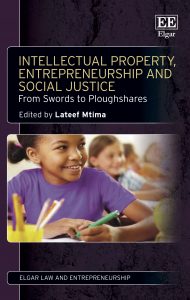
In the Information Age, historically marginalized groups and developing nations continue to strive for socio-economic empowerment within the global community. Their ultimate success largely depends upon their ability to develop, protect and exploit their greatest natural resource: intellectual property. Through an exploration of the techniques used in social entrepreneurship, Intellectual Property, Entrepreneurship and Social Justice provides a framework by which historically marginalized communities and developing nations can cooperate with the developed world to establish a socially cohesive global intellectual property order. Divided into four parts, knowledgeable contributors discuss topics surrounding entrepreneurship and empowerment, education and advocacy, engagement and activism and, finally, commencement toward “IP Empowerment”. Experts in the field, scholars, law professors and students of intellectual property, human rights and international trade and development will find this book to be both resourceful and thought-provoking.
IIPSJ IP and Civil Rights Conference | 2012
IIPSJ's IP and Civil Rights Conference was held on Thursday, May 17, 2012 at the Howard University School of Law. Rev. Jesse Jackson Sr. was the keynote speaker. The conference brochure in pdf form is available for download. The conference was cosponsored by IIPSJ and the Black Leadership Forum (BLF).

From left to right: IIPSJ Director Lateef Mtima; Rev. Jesse Jackson; Prof. Roger Groves (Fla. Coastal School of Law); IIPSJ Assoc. Dir. Steven Jamar at IIPSJ IP and Civil Rights Conference - May 17, 2012.
Further Commentary on the Washington NFL Football Team Trademark
As we settle into 2015, we thought you might be interested in a commentary regarding the continuing debate surrounding the name of the Washington NFL football team, Missing the Point: The Real Impact of Native Mascots and Team Names on American Indian and Alaska Native Youth, written by Eirk Stegman, Associate Director of the Half in Ten Education Fund at the Center for American Progress, and Victoria Phillips, who teaches intellectual property and communications law at American University Washington College of Law and is the Director of the Glushko-Samuelson Intellectual Property Law Clinic. Stegman and Phillips discuss the psychological impact of the team’s controversial appellation, noting that “…too much of the debate misses the point. It is not just about a name, a logo, a business, or a matter of intent. Racist and derogatory team names have real and harmful effects on [American Indian and Alaska Native] people every day, particularly young people.” Among other things, the authors note that “AI/AN students across the country attend K-12 and postsecondary schools that still maintain racist and derogatory mascots.
Research shows that these team names and mascots can establish an unwelcome and hostile learning environment for AI/AN students. It also reveals that the presence of AI/AN mascots directly results in lower self-esteem and mental health for AI/AN adolescents and young adults. And just as importantly, studies show that these mascots undermine the educational experience of all students, particularly those with little or no contact with indigenous and AI/AN people. In other words, these stereotypical representations are too often understood as factual representations and thus “contribute to the development of cultural biases and prejudices.”
To read the full commentary, follow the link at https://www.americanprogress.org/issues/race/report/2014/07/22/94214/missing-the-point/
Past internship Placements
Awards earned by students in 2005
Tameka Simmons '05
Ms. Simmons won the 2005 Jan Jancin Award for demonstrating excellence in intellectual property law. Ms. Simmons stands out through her remarkable service, while still a law student, in furthering IP pedagogy at the law school and in CLEs, through her dedication and service to IIPSJ and related HUSL programs, and to the IP Bar. The Jan Jancin Award is a national IP award open to all law schools (a number of whom have large IP and technology transfer programs) and to all of their students. This award is sponsored by the American Intellectual Property Law Association (AIPLA), the American Intellectual Property Law Education Foundation (AIPLEF), and the Intellectual Propert Section of the American Bar Association.
Letoria House '06
At the 2005 annual Giles S. Rich Inn of Court Dinner (at which Sen. Patrick Leahy was the keynote speaker), Letoria House received the Giles S. Rich American Inn of Court Scholarship. This award is bestowed upon a recently admitted lawyer or a law student who has contributed significantly to the Inn as measured by "the degree and quality of participation" and by the person's "contribution to fulfilling the Inn's Mission." Part of the Inn's mission to further the principles of civility, professionalism, and competence in the practice of law. The GSR Scholarship is open to junior Inn members practicing throughout the DC/Maryland/Virginia region and to the student members of the GSR Inn from the five participating law schools (HUSL, Georgetown, Catholic, American, and George Mason).
Stephanie Harris '07
On the eve of her matriculation to HUSL, Ms. Harris became HUSL's first recipient of a Sidney B. Williams, Jr. Intellectual Property Law Scholarship sponsored by the American Intellectual Property Law Education Foundation. This scholarship is open to minority students throughout the nation. It is awarded to minority students with demonstrated accomplishment and potential in the field of IP practice. Ms. Harris's scholarship was renewed in 2005 on the basis of her continuing accomplishments as a HUSL student.
On a related note, Sid Williams, for whom the scholarship is named, is a great friend of HUSL, having served as IIPSJ's inaugural keynote honoree when IIPSJ was launched in 2002.