Blog Post On Likeness Legislation
Recent Name/Image/Likeness Legislation Will Change the NCAA (or Not)
 by Ronald S. Katz
INTRODUCTION
In a list of organizations creating inequities, the National Collegiate Athletic Association would certainly be included. For example, like professional sports, the NCAA is a multi-billion-dollar enterprise, but, unlike professional sports, it pays only a minuscule percentage of its revenues to its athletes, mainly in the form of athletic scholarships. In the field of intellectual property, those players have not been allowed to receive payments for their names, images and likenesses, even though every other student on campus has that right.
To remedy this latter injustice, California in September 2019 passed the Fair Pay to Play Act, allowing athletes rights regarding their names, images and likenesses similar to those enjoyed by all other students. Numerous other states are considering NIL legislation similar to California’s.
Because college sports receive much public attention, the California law, which does not come into effect until 2023, has generated numerous opinions about its potential effect. The extremes of those opinions range from those who say that the law will end intercollegiate sport as we know it to those who say that the law will have no effect. The NCAA has now also weighed in, stating, opaquely, that it will at some unknown point “permit” college athletes “the opportunity to benefit” from their name/image/likeness “in a manner consistent with the collegiate model.”
In fact, at this juncture, no one can really say what the effect, if any, of the law will be. That point was driven home by an order rendered on January 6, 2020, by the federal appellate court with jurisdiction over California, the Ninth Circuit Court of Appeals. Pursuant to that order, in the pending appeal (No. 19-15566) of In re: National Collegiate Athletic Association Athletic Grant-in-Aid Cap Antitrust Litigation, a case concerning the payment of college athletes, “The parties are directed to file…briefs…on the impact, if any, of California’s Fair Pay to Play Act…on this case.”
If the judges of the Ninth Circuit do not yet know the effect of the NIL law, it is fair to say that no one else does either. In my opinion, the best that can be done at this point, as below, is to put the law into context by triangulating among the extreme opinions noted above and the NCAA’s position on the Fair Pay to Play Act.
EXTREME OPINION #1: NIL LEGISLATION WILL END INTERCOLLEGIATE SPORT AS WE KNOW IT
There is logic supporting this view. For example, there is no difference in economic effect if an athlete receives from an alumni booster of a university $10,000 under the table, which violates NCAA rules; $10,000 in salary, which violates NCAA rules; or $10,000 for name, image or likeness, which would be legal under the Fair Pay to Play Act and, possibly, under new NCAA regulations. Because money is fungible, it really does not matter, in an economic sense, for what reason it is purportedly paid. Therefore, payment for names, images and/or likenesses can completely undermine the NCAA principle that athletes should not be paid. The amounts paid, in theory, could be virtually unlimited.
EXTREME OPINION #2: NIL LEGISLATION WILL HAVE NO EFFECT
This extreme view has support in the law. Under the Commerce Clause of the U.S. Constitution, states cannot make laws that regulate interstate commerce, and intercollegiate sports clearly constitute interstate commerce, viz., the NATIONAL Collegiate Athletic Association. Indeed, a case decided by the Ninth Circuit Court of Appeals in 1993 (NCAA v. Miller, 10 F.3d 633) applied this principle to intercollegiate sports.
In that case, Nevada made a law that would have caused NCAA disciplinary proceedings to have rules in Nevada different from those that the NCAA applied nationally. Like the Fair Pay to Play Act, the Nevada law had been emulated in other states.
The court did not hesitate to invalidate the Nevada statute on the ground that it regulated interstate commerce in violation of the U.S. Constitution: “The statute directly regulates interstate commerce and runs afoul of the Commerce Clause both because it regulates a product in interstate commerce beyond Nevada’s state boundaries, and because it puts the NCAA…in jeopardy of being subjected to inconsistent legislation arising from the injection of Nevada’s regulatory scheme into the jurisdiction of other states.” It is difficult, if not impossible, to distinguish the judicial reasoning applied to this Nevada legislation from the judicial reasoning that would be applied to California’s Fair Pay to Play Act.
THE NCAA’S OPAQUE PRONOUNCEMENT
As noted above, in October, 2019, after the California law passed, the NCAA issued a vague statement to the effect that It will study how college athletes may be paid for their names, images and/or likenesses “in a manner consistent with the collegiate model” at some unstated point in time. One problem with the NCAA’s statement is that the collegiate model is nowhere clearly defined.
Underscoring that fundamental problem is that the District Court decision being considered in the Ninth Circuit order mentioned above (In re Nat’l Collegiate Athletic Ass’n Athletic Grant-in Aid Cap Antitrust Litig., No. 14-MD-02541 CW, 2019 WL 1747780, (N.D. Cal. Mar. 8, 2019)) concluded that the NCAA rules “that permit, limit, or forbid student-athlete compensation and benefits do not follow any coherent definition of amateurism,” which is the core principle of the NCAA. This finding was based, among other things, on inconsistent definitions of amateurism given by different NCAA witnesses and on the fact that at trial, according to the court’s opinion, there was evidence of seventeen different ways-such as payment for post season bowl or championship play–that the NCAA permits athletes to be compensated.
Thus, whatever the NCAA’s definition of an amateur is, it does not comport with the dictionary definition: “a person who engages in a study, sport or other activity for pleasure rather than for financial benefit or professional reasons.” Given the above, it is difficult to divine how the NCAA will create a system of payment for athlete names, images and likenesses “consistent with the collegiate model.” It should be noted that payment for the names, images and/or likenesses of athletes rarely have a connection to education.
CONCLUSION
Intellectual property injustice is a symptom of the NCAA’s underlying problem, and the Fair Pay to Play Act is a reaction to that symptom. The fundamental problem of the NCAA is that its top levels are indistinguishable from professional sports, and the theory of amateurism-however that is defined–does not work in that context. Whether the Fair Pay to Play Act survives or not, the pressure will continue to bring the regulation of college sport in line with its reality.
Ronald S. Katz is a Senior Counsel at GCA Law Partners LLP. A co-author of Sport, Ethics and Leadership, he will be speaking on the subject covered above at the 2020 IP and Social Justice CLE this coming February 28.

Fair Pay to Play Act
The California Fair Pay to Play Act- Finally IP Social Justice for Student Athletes
Earlier this month Governor Gavin Newsom signed into law the Fair Pay to Play Act, the nation’s first law to override the NCCA’s prohibition which prevents student athletes from commercially exploiting their IP and related legal rights. See California Law Takes Paying College Athletes Out of the NCAA's hands. The NCAA maintains its rule notwithstanding the fact that the NCAA requires student athletes to permit the NCAA to exploit those very same rights to obtain millions in revenues every year.
For years, some legal scholars (see e.g. Lateef Mtima, What's Mine Is Mine but What's Yours Is Ours: IP Imperialism, the Right of Publicity, and Intellectual Property Social Justice in the Digital Information Age) and many social activists have urged that the NCAA rules allowed the grossly unfair exploitation of student athletes, many of whom hail from marginalized, working class, and rural communities, and for whom the college athletic scholarship system provides the only opportunity to obtain a college education. Although at one point it seemed that the courts were willing to curtail NCAA rules and allow students to protect their IP rights from unfair exploitation, this progressive wave came to a halt when the United States Court of Appeals for the Ninth Circuit overturned a California District Court ruling that the NCAA prohibition violates the federal antitrust laws. Instead, the Court of Appeals declared that the NCAA rule satisfies the antitrust “rule of reason” doctrine, which effectively permits an antitrust violation where the social benefits outweigh the social harms (raising the question as to whose “benefits” count and whose “harms” don’t.)
Under the new law, college athletes in California will be permitted to accept commercial endorsements and hire agents beginning in 2023. Hopefully the Fair Pay to Play Act will inspire similar legislation in other states, and finally allow all student athletes to share in the millions of dollars of commercial revenues they generate every year.
We will continue this important conversation during our annual CLE program.
In Memoriam Donald Dunner
In Memoriam
Donald R. Dunner: A Leader in Patent Legal Practice and A Champion for IP Social Justice
On October 16, 2019, the legal profession and the IP social justice community lost one of their pillars when Donald R. Dunner, name partner at Finnegan, Henderson, Farabow, Garrett & Dunner, LLP, passed away at the age of 88. Donald R. Dunner enjoyed a distinguished legal career and leaves an indelible imprint on contemporary patent law and practice.
One of the most accomplished and influential patent lawyers of his generation, Don Dunner helped to shape the contours of contemporary patent legal practice, not only through his successful representation of a wide array of clients, but also in supporting the progressive evolution of patent law. Under his auspices in 2003, the Finnegan law firm began its collaboration with IIPSJ to establish the nation’s first IP and Social Justice Continuing Legal Program, developed and implemented by Finnegan attorneys Tom Irving and Esther Lim and hosted by the Howard University School of Law. Now in its seventeenth year, the IIPSJ CLE program continues to educate IP attorneys and policy makers from around the nation as to the social justice obligations and opportunities presented by IP protection.
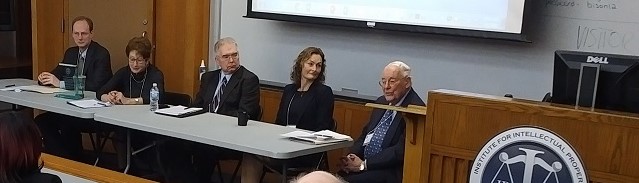
One of the program’s most highly regarded features is the Judicial Roundtable Panel, wherein Don Dunner would moderate an annual open conversation with sitting members of the federal judiciary and explore cutting edge developments in the field of IP law, including important issues which implicate the law’s social justice resonance in the total political economy. Don would often use this opportunity to ask the judges to share guidance for students in the audience seeking clerkships. It was Don Dunner’s stature and reputation in the patent bar that attracted leading jurists to share their insights and perspectives and thereby make the Judicial Roundtable Panel and the IP and Social Justice CLE program a unique and highly respected professional education experience.
While Don Dunner’s practice impacted major issues in patent law, his professional efforts went beyond “top down” approaches to improving the field. A thoughtful and earnest mentor, Don Dunner guided the professional development of many junior attorneys, and along with many of his colleagues at the Finnegan law firm, he was personally engaged in supporting initiatives to enhance racial and gender diversity within the IP bar. Through these efforts many attorneys gained exposure to IP legal practice and the opportunity to participate in IP-oriented internship programs and full-time practice at Finnegan and other IP law firms, and to practice IP law in various corporate in-house counsel and government legal departments.
Donald R. Dunner leaves an impressive legacy in the field of IP legal practice. From his work in various governmental commissions and studies to evaluate and improve the patent system, to his service as president of the American Intellectual Property Law Association, Chair of the American Bar Association’s IP Section, and as a recipient of the AIPLA Board of Director's Excellence Award, Don Dunner contributed much to the profession he cherished. He will be greatly missed by all of us who had the privilege to work with him, even as we continue to appreciate his enduring impact on IP legal doctrine, professional education, and the social justice aspirations of IP protection.
Arts and Entertainment Advocacy Clinic
Services offered: The Arts & Entertainment Advocacy Clinic allows students to develop substantive legal knowledge in copyright and related areas of law as well as practical skills in research, writing, and advocacy by counseling clients and preparing legal and policy documents on behalf of artists and creators.
Information Packet for the Legal Clinic - Practical Preparation of Patent Applications.
Glushko Samuelson Intellectual Property Law Clinic
Services offered: The full range of intellectual property specialties — copyright, patent, trademark, and beyond — in a variety of settings — including client counseling, rights acquisition, transactional lawyering and negotiation, litigation, and administrative and legislative advocacy.
Eligibility criteria: Individual creators and users of intellectual property, small businesses and communities of rights holders and consumers, not for profit institutions and associations, and other entities.
Regions covered: All
Fees charged: Free, however clients generally must pay for other costs of legal representation, such as governmental filing fees and litigation-related costs.
Detkin Intellectual Property and Technology Legal Clinic
Services offered: The IPC provides pro bono transactional patent, copyright, trademark and trade secret services to individuals, non-profit and for-profit clients in technology and the arts.
Entrepreneurship Legal Services
Services offered: Start-up company IP issues, such as trademark applications, provisional patent applications and patent research.
Eligibility criteria: Must be a start-up company without significant revenue.
Regions covered: All
Fees charged: $25.00 per hour for student time
Cyberlaw Clinic
Services offered: The Clinic maintains an active practice in intellectual property advising, including risk assessment, and has drafted a wide range of transactional documents that relate to IP rights (including license agreements and other documents concerning transfers of intellectual property).
Public Patent Foundation
Services offered: Reexaminations of patents. Pre-litigation counseling, representation and negotiation. Representing defendants in patent litigation. Patent-related only. (No trademark or copyright services.) No patent applications or prosecution.
Eligibility criteria: Economically disadvantaged businesses (including sole proprietors, partnerships, corporations or other entities) accused of infringing dubious patents.
Regions covered: Nationwide in U.S.A.
Fees charged: Clients are expected to pay costs, but normally not attorney fees.
Public Interest Intellectual Property Advisors, Inc. (PIIPA)
Services offered: PIIPA is the global non-profit resource for developing countries and public interest organizations seeking expertise in intellectual property matters to promote health, agriculture, biodiversity, science, culture, and the environment.
Eligibility criteria: Assists governments of developing countries, non-profit organizations in developing countries, and non-profit organizations in developed countries that help developing countries.
Regions covered: All developing countries
Fees charged: None